Nestled in Rome's Most Magical Piazza, This Grand Tour-Era Hotel Captures the City's Layered Heritage Into a "Gesamtkunstwerk" — With Help From Its 'Sun-Baked' Palette
"You can travel emotionally through architecture and interior design, through atmospheres, scents, music, textures, or even the way light enters a space," designer Hugo Toro says of his intention for Orient Express La Minerva

I have been walking for a few minutes when the Pulcino della Minerva, a curious, fanciful sculpture standing tall in Rome's hyper-central yet mysteriously calm Piazza della Minerva, appears against a darkening sky to my right. Depicting a doe-eyed elephant carrying an ancient Egyptian obelisk (one of the 12 dotting the Eternal City's traveled piazzas, and the smallest of its kind), this fascinating landmark is the work of pioneering Italian sculptor Gian Lorenzo Bernini. It has sat in the square since it was first unveiled in 1667, a symbol of the strong intellect (the elephant) and the divine wisdom (the obelisk) that, at least for Pope Alexander VII, characterized the Romans.
Now, picture how many travelers before me that statue must have seen over the past 359 years — how many love stories, adventures, crimes, and plot twists must have unfolded in the stretch that goes from the white-marble, affective grin of that colossal animal to the Pantheon, situated in Piazza della Rotonda behind its back. That's where the story of Orient Express La Minerva, the debut hotel in Rome of the namesake lifestyle brand, begins. Or better even, where, looking straight at it, it starts again, with one challenge as its incipit: "working with the existing traces of history present all around it to create a dialogue between the location, the building, and the identity of Orient Express," Franco-Mexican architectural designer Hugo Toro tells me.
A mission the Paris-based creative set out to pursue by looking into the numerous strati of heritage that characterize the Eternal City, starting from the most superficial one: the sun-baked, lived terracotta hue that imbues its edifici. And trust me when I say the result will make you want to repaint your home instantly.
Orient Express La Minerva — Crafting "a Total Work of Art" Begins With the Right Palette

La Minerva Bar, the ground-floor bar and breakfast restaurant of Orient Express La Minerva, offers the perfect entry point into the hotel's rich storytelling.
Orient Express La Minerva calls the former Palazzo Fonseca, a 17th-century aristocratic mansion built around 1620, its home. The building was later transformed into a hotel in 1811, at the peak of the Grand Tour era: a merging of worlds Toro faithfully reinterpreted in his work.
"Rome is a city of controlled chaos, vibrant, layered, and deeply historical," he says. Its multiple facets — the papal rigour, the noble lavishness, the popular appeal of a city that's most alive along its worn vicoli — are all equally present in this stay's interior scheme.
The secret to its pervading beauty, it seems, lies in indoor spaces that borrow from Rome's outdoor frenzy. So that, when the tall doors at Piazza della Minerva 69 open up before you, the immersion in art, culture, and craftsmanship that distinguishes the Italian capital can continue.

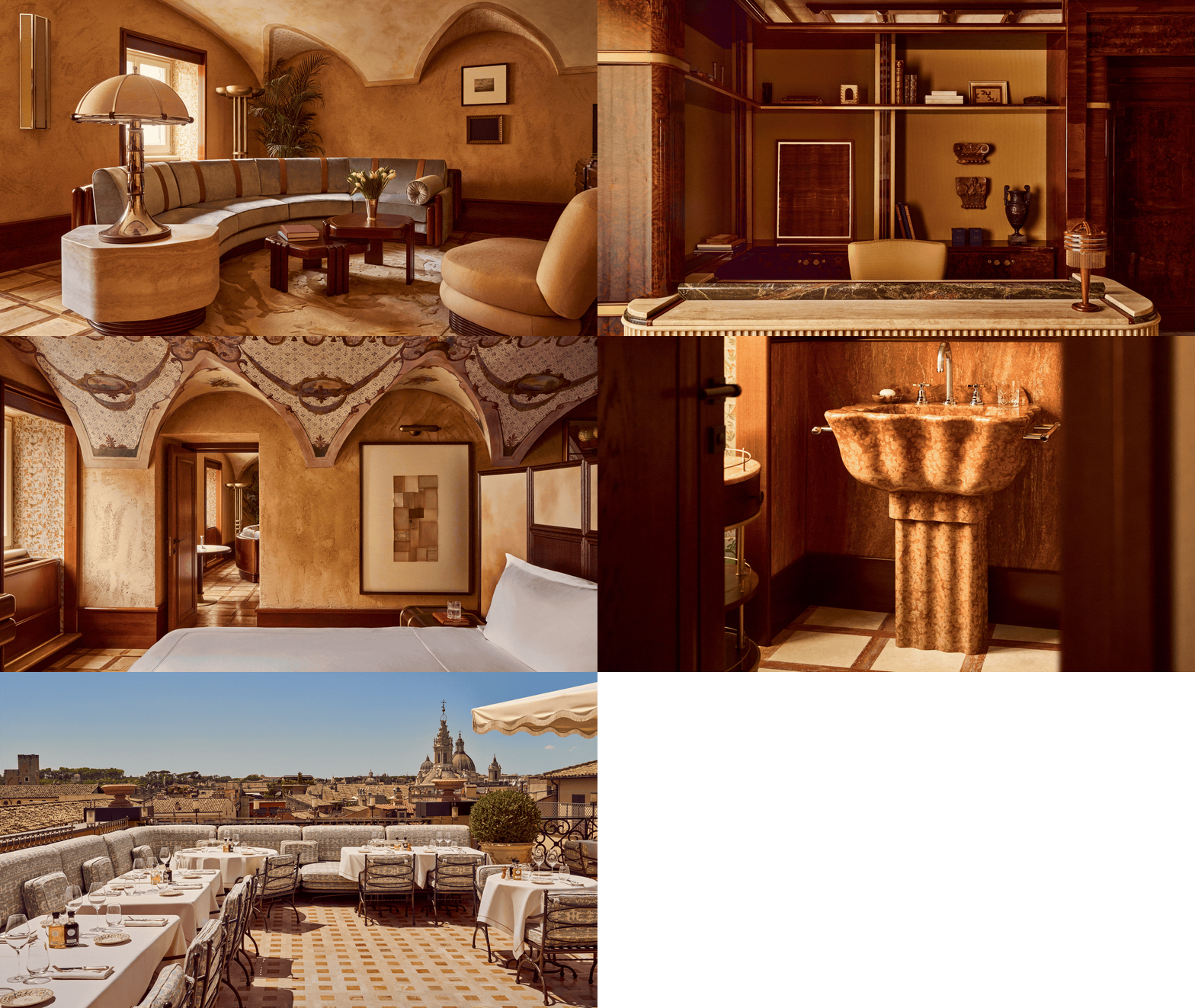
A detail from the bathroom of the Deluxe Room at Orient Express La Minerva reveals the quietly unfolding dialogue between the inside and Rome's spellbinding outdoors.
"The plasters used inside the rooms are similar to the ones used on the exterior facades of the surrounding Roman buildings," the architectural designer explains, describing how the texture and the earthy choice of colors of the walls establish "a subliminal dialogue with the city."
In Rome, the sunset-tinted, golden light bouncing off legendary churches and palazzos and humble bottegas alike is the first thing to make you feel at home — and the memory that will keep you coming back time and time again.
At Orient Express La Minerva, the conversation between the city's nature and architecture and the hotel's own environment unfolds as a series of burned oranges and ochres, deep reds, cream notes lighting up the solid browns, and lush greens, whether applied straight to its surfaces or integrated through thriving plants and striking tilework.
It's a chromatic range that makes the magic of Rome collectible, and even easy to replicate in your home (especially with this Little Greene Clay paint, or this Terre D'Egypte and Sudbury Yellow by Farrow & Ball).
... and Proceeds With More Carefully Sourced or Fully Bespoke, Layered Touches

"Rome is built on stratification — of ruins, materials, and textures. You see rough plasters, stone frames, fragments of earlier structures. In the hotel, we introduced another layer, often through polished wood elements." — Hugo Toro
What I find most refreshing about Orient Express La Minerva is that, despite its majestic setting, every design detail seems to beg to be touched, to be lived, by those who come across it rather than simply being there to be observed.
It's a relationship that starts at the reception, where a marble-topped desk guides guests' fingers as they wait for check-in along its wavy inlets, while shelves styled with carefully placed antiques and objects d'art keep their eyes engaged.
"Rome itself is a city built on stratification — of ruins, materials, and textures," Toro adds. All around it, "you see rough plasters, stone frames, fragments of earlier structures. In the hotel, we introduced another layer, often through polished wood elements."
This contrast between raw and precious materials became a guiding theme throughout the property, its 93 rooms and suites, communal areas, and eateries.

The frescoed ceilings of the Stendhal Suite, a masterpiece to sleep in, complete with a Rosso Verona marble bathroom, a private bar, and a record player.
Image credit: Alexandre Tabaste. Design: Hugo Toro

And its panoramic, aesthete-ready lounging area, filled with private views of the Pantheon and Piazza della Minerva.
Image credit: Alexandre Tabaste. Design: Hugo Toro
Concretely, this was achieved with a standout curation of bespoke and meticulously sourced elements. "Around 95% of the furniture, lamps, and carpets were designed specifically for the project," Toro explains. "Each of the rooms has a different layout, creating a very unique experience for guests."
All headboards, for example, cast from wood and inlaid with silky, pastel-shaded panels, were painted by hand to harmonize with the Roman skies.
"They're all unique," assures the designer, who drew from the look of 1920s steamer trunks to evoke the glamour of the golden age of travel (Orient Express La Minerva is the first overnight stop for globetrotters embarking on any Rome-departing itinerary of La Dolce Vita Orient Express, one of the hottest luxury train rides of the moment).
My room, a Junior Suite situated on the fourth floor, had an opalescent sky-like headboard, crafty pendant glass lamps emanating a soft glow on either side of the bed, and a velvety corner couch, curtains, and bathroom tiles all painted a bright pale blue. Oh, and plenty of spectacular artwork hung around its spacious, amber-toned interiors, too.


It's Rooted in "Continuity" — Or Time-Traveling Yet Cohesive Choices

The carpets of the hotel was realized off paintings Toro made themselves, which were later transformed into the tapestries of colors people can now experienced at Orient Express La Minerva.
While all the rooms share the same design DNA, some suites include special elements that reinforce the narrative: "for the Exclusive Suite, I designed sculpted fireplaces with bas-relief decorations, which bring a very particular ornamental dimension to the space," Toro says.
Bas-reliefs also appear in some of the bathrooms and other parts of the hotel, such as the cinematic Minerva Bar (captured above) and the Spirito area. As "for me, continuity is important," the designer adds. Although that kind of architectural detail will be harder to incorporate (or frankly, to justify budget-wise) into your home, this doesn't mean you can't start small.
Getting into art and antique collecting, for instance, could help you retrieve elegantly framed paintings, photographs, and illustrations, precious ephemera, and one-offs that can give your place that Orient Express La Minerva-inspired modern classic look. Simply dig into the archive of 1stDibs, one of the world's leading platforms for all things vintage decor and fashion, and get searching.


Last but Not Least: Stimulate All the Senses

"Travel does not necessarily require movement. You can travel emotionally through architecture and interior design, through atmospheres, scents, music, textures, or even the way light enters a space." — Hugo Toro
The idea of travel underpins the atmosphere of the hotel. "What interests me is the idea that travel does not necessarily require movement: you can travel emotionally through architecture and interior design, through atmospheres, scents, music, textures, or even the way light enters a space," Toro explains.
The communal areas of the stay, from the One Thousand and One Nights-like, wood-sculpted hammam and spa to the panoramic terrace of Gigi Rigolatto Roma, the address's rooftop restaurant and bar, and the Minerva Bar, the latter of which currently hosts a temporary takeover by Campanian culinary gem Paolino Capri that will transport you straight to the lemons-dotted Amalfi Coast, make for "a complete, immersive, 360-degree experience".
"Rome is a Mediterranean city, very solar and radiant, yet we sometimes forget that it is also close to the sea," the designer says of the concept behind Gigi Rigolatto, one of the most spectacular rooftops in the whole of Rome, as seen in the latest season of Emily in Paris.

At Orient Express La Minerva, the timeless charm of Rome is at your fingertips, and at your doorstep.
The restaurant's wide, hyper-fresh seafood offering — think stunningly plated crudo and fish tartare, perfectly grilled octopus, and yes, ever-so-delicious, melt-in-your-mouth squid 'tagliatelle' — is complemented by romantic, yacht-style upholstered wooden seating and banquettes, sculptural table lamps, and wavy, striped drapery keeping guests warm and dry at night.
"I wanted to evoke a more maritime atmosphere," Toro says of the hotspot. "I painted motifs using more blue tones, and we introduced references to shells and marine mythology, inspired by the many fountains in Rome depicting sirens and tritons."
The standout gastronomic experience one can savor here, where Roman staples like juicy artichokes and nutty pecorino are enjoyed alongside invigorating fish mains and comforting pastas, shouldn't be seen as separate from the terrace that hosts it.
In Toro's vision, "architecture, interior and furniture design, decorative arts, and details must all come together as a unified composition," he says. The Paris-based creative thinks of his hotel designs "as a kind of gesamtkunstwerk, where different artistic disciplines converge to create something singular". One thing is for certain: I have never seen anything quite like Orient Express La Minerva anywhere else.
Book your stay at Orient Express La Minerva.
In more Orient Express news... did you know that the legendary train is set to hit the tracks again next year? Read on to learn more. Meanwhile, elsewhere in Rome, at the kaleidoscopic Palazzo Talìa, director Luca Guadagnino's first designed hotel, another storytelling-led stay unfolds minutes away from the Spanish Steps.
Speaking of cinematic holidays, don't miss your chance to holiday in the filming locations of Christopher Nolan's The Odyssey, as they hold far more design gems than you'd expect at a first glance.
Can't get enough? Subscribe to our newsletter for round-the-clock culture, lifestyle, and travel inspiration.
