In the New Callum Turner Satirical Thriller 'Rosebush Pruning', the Villa Was Never Meant to Feel Like Home, Says Its Production Designer
The twisted family's material obsession, faults, and fragilities show in more than just designer clothing

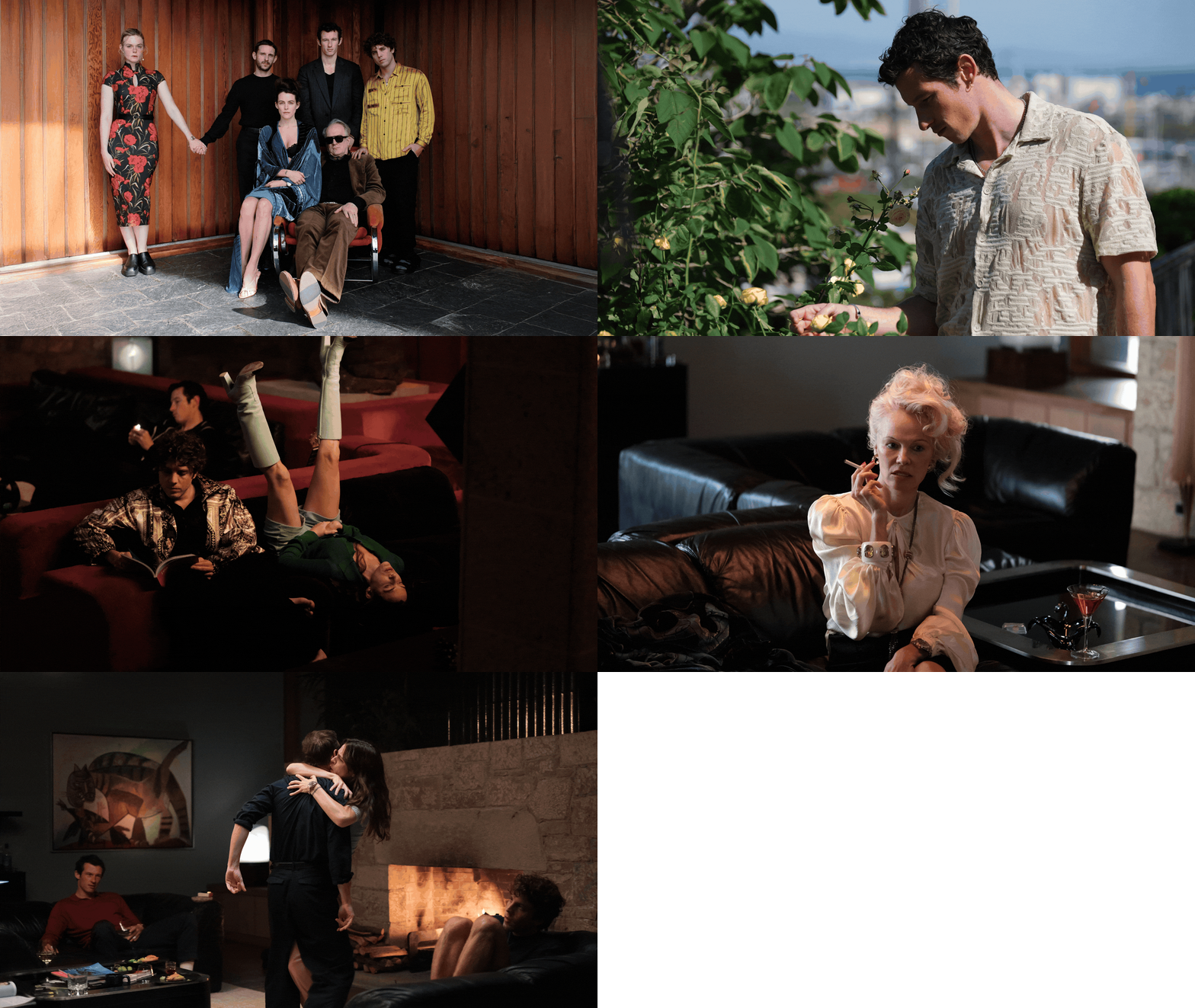
All that glitters is not gold, an old saying goes, and that is clear within seconds of glimpsing the seemingly glamorous yet morally corrupt reality inhabited by the broken American family of billionaires that serves as the beating heart of Karim Aïnouz's new satirical thriller, Rosebush Pruning.
No coveted mid-century modern furniture piece, sinuous sports car, or designer bag can hold together the saturated, sumptuous paper castle siblings Ed (Callum Turner), Anna (Riley Keough), Robert (Lukas Gage), and Jack (Jamie Bell) have built alongside their widowed father (Tracy Letts) with the money inherited from their deceased mother (Pamela Anderson), each nook in their sprawling Catalonia countryside villa a temple to their self-destructive vanity. Not that they aren't aware of that, either.
"This fact that none of us ever had to work, ever in our lives, didn't affect our characters," Callum Turner's magnetic Ed explains in a suspense-building passage of the film. "We always were interested only in music and fashion. We were all lazy, mediocre, vapid egotists. All of us. Except for my eldest brother, of course, Jack. Jack's different. Poor Jack." What's the price to pay for being different? That's what the twist-ridden plot of Rosebush Pruning indirectly answers, as it exposes the rotting essence of the relatives' material existence.
Dressed head-to-toe in custom and vintage Versace, Bottega Veneta, Hermès, McQueen, and Chanel, to name a few, and surrounded by all sorts of possessions others could only ever imagine, the family doesn't lack anything, at least in theory. In practice, what eats them from within is their inability to relate to one another, production designer Rodrigo Martirena tells me over Google Meet, speaking from the location of his next film job in Brazil. Their lust for connection, depraved fantasies, flaws, and fragilities are the blueprint around which he built their domesticity; director of photography Hélène Louvart's sun-drenched aesthetic is the thermometer measuring tension as it builds.
What Was the Original Intention Behind the Making of 'Rosebush Pruning'?

After Ruben Östlund's Triangle of Sadness and Haley Z. Boston's Netflix show Something Very Bad Is Going to Happen, the film world is back satirizing the ultra-rich elite. Production designer Rodrigo Martirena explains why it's not as easy as it seems.
"Years ago, people talked about millionaires. Now, we are talking about billionaires and what they do with their money. While filming Rosebush Pruning, for example, the Epstein files were released. We see all the disgusting things that are taking place in the world, and cinema being a political thing gives people a different way or perspective to look at what's happening.
"The idea for Rosebush Pruning was not to show the luxury and the wealthy, how it is and feels to be rich, but to try to get to the psychology of this rich family — to create the environment to understand why they are so deranged. After the pandemic, isolation is a theme and situation we all feel really strongly about and understand. We put this very concept into the film, which follows an isolated American family with a lot of money who live by themselves in a villa tucked away in the Spanish countryside. What happens to them? Well, they go nuts."
Tell Us About the Spanish Villa the Film Is Set in — What Made It the Ideal Home for It?

"The idea for Rosebush Pruning was not to show the luxury and the wealthy, how it is and feels to be rich, but to try to get to the psychology of this rich family — to create the environment to understand why they are so deranged," Martirena explains.
"When I read the script, I knew that finding the right house was the most important thing, as 80% of the film would be shot there. It was always very clear to me that a Brutalist-style building would be the perfect place to portray this family. Born in post-WWII UK, Brutalism goes to the root of the material, showing concrete at its rawest, barest.
"The distinctive trait of Brutalist houses is that, once you are inside, you are not just inside a house. You're inside its structure; you see its bones, unfinished and uncovered. That situation, that feeling, is like being in a jail to me. And I knew that's what we needed to tell Rosebush Pruning's story.

Cement, glass, stone, and wood serve the architecture to Karim Aïnouz's gut-wrenching satirical thriller Rosebush Pruning.
"We wanted a Brutalist, functional house where the entire movie could be filmed, with five good-sized bedrooms with en-suite bathrooms. We settled on a villa located a few kilometers north of Barcelona, Catalonia. The first detail to catch my eye was its entrance: a concrete structure very similar to Le Corbusier's Notre-Dame du Haut chapel in Ronchamp. I looked at it and thought, 'I am walking into a temple.'
"At some point in the film, a delivery guy riding an electric motorbike stops right in front of it, his silhouette microscopic against the imposing cement roof. It's a detail that reflects the contrast pervading every scene of Rosebush Pruning, ideal for immortalizing the oppressive psychology of the family."
What's It Like Inside? Were There Any Quirky Details That Had You Say "This Is the One"?

Pamela Anderson's art house moment continues in Rosebush Pruning, where she delivers a remarkable performance as a matriarch who decides to take life into her own hands.
"At first glance, it might make you think of Frank Lloyd Wright — the wood, the stone, the glass, the lines — but the scale of this place is nothing like his low-rise Fallingwater house. It is the opposite: it's vast, with a central patio opening up like the Pantheon. The idea with this residence was to combine its different architectural and decorative elements to build the Rosebush Pruning world.
"Near the main entrance, for example, we found six golden deer. It was the most amazing coincidence, as not only is the family made of six people, but initially, Karim and I had even discussed the weird idea of them having deer instead of dogs as pets inside the house. When we arrived and saw them on the doorstep, we said, 'of course, this is the one.'

A preparatory sketch for Robert's bedroom.
Image credit: Yannick Olivar

His character's hedonistic essence is turned into design accents.
Image credit: Rodrigo Martirena
"The other great thing about the house is its double circulation: you have an interior circulation, connecting all the rooms, and an exterior one, which does the same but through a wrap-around terrace. That meant you could go from bedroom to bedroom from both inside and outside, and show the continuity of that — how big the house is — in very long shots.
"As we ventured deeper into our visit of the property, we uncovered all of these stunning textures. The cherry on top, though, lay in the bedrooms, which had carpeted walls, the most claustrophobic, stifling material in the world, dirty and a little bit disgusting. They had stripes and all sorts of patterns, which inspired me to associate each sibling with different motifs and materials."
In 'Rosebush Pruning', You Built the Characters' Bedrooms to Be a Mirror of Their Personality. How?

"It might sound naive, but like in many other stories before this one, in Rosebush Pruning, too, it's love that changes everything. Because of the love between Elle and Jack's characters, the whole story shifts," Martirena reveals.
"It all comes from the script, the individual characters, and the scenes that are set to take place in each space. Robert's bedroom, for example, had to feel very hedonistic, and so we worked with sensual materials. Fetishist interior elements, like tubes that can be used to tie someone up to the bed headboard, have been included in the scheme to create expectation: you don't necessarily see them, but you feel them; you know something is waiting to unravel there.
"Robert struggles with his mental health — he is on medication — and is not allowed to drive. So he loves playing with little car models, which we placed in a corner of the room. Nobody will notice them, but they are there. I also hid a golden reflection in the closet as a teaser of what will happen...
"Ed, on the other hand, studies a lot how to fake his voice. He has a very nice bedroom, mainly concentrated on this 'voice' situation: there is a corner styled like a podcast recording setup, instrumental to something that will unfold later in the script between him and his father. The father himself has a very big bedroom — bigger than most, really, more like a living room.

Riley Keough as Anna and Lukas Gage as Robert, as seen in a basement moment from Rosebush Pruning, the red-tinted walls of the room setting the atmosphere.
"Here, the wardrobe area is crucial, and you'll realize why when you watch the film. From his exterior, forest-facing bedroom terrace, he can access and control the rest of the house even if he's blind. My idea was to use textures on the walls similar to the siblings' rooms, but treated in a more modern, cleaner, less 'over-the-top' way. Because the oppressive feeling belongs to the siblings, the father is up in the clouds.
"Anna's bedroom was even more complex. After her mother's disappearance, she is the only woman living in the house, constantly cooking and prepping the clothes. She acts like a servant for her own family and is always asking herself, 'what am I even doing here?' Anna is obsessed with faces, so we designed a metal mask with glass fragments for eyes. This also links to her blind father, whose relationship with her is very strong and, at the same time, creepy and sickening.
"In her case, objects were the most important thing. When her father dies, Anna is in her bedroom alone. Behind the head sculpture resting on her desk, we see something we created specifically for her: roses, wrapped in a plastic bag. Why? Throughout the film, we see her cooking and wrapping up leftovers in cling film. She is used to conserving everything that way, and tries to do the same with the last memory she gets of her dad, as if immortalizing that situation forever."
The Family Feels as Trapped in Their Own World. What Specific Design Elements Allowed You to Convey That Situation?

A kitschy electronic Roche Bobois bar, a sleek Bang & Olufsen sound system, and a feral Picasso canvas: the basement is where the family's absurdities, material obsession, and quirkiness crystallize.
"One of the environments that renders this best is the basement. Entirely red and equipped with a fireplace, it is where the siblings spend time sitting in strange, tense positions.
"That space, for me, was the cave inside the cage that's their home: upstairs, the whole family is together, but downstairs it's just the siblings, talking about things meant only for them, and about their father. The idea was to frame it as an interior within the interior. It is the only place where red is so prominent, and that's because it is where the tension between the siblings reaches its climax.

Callum Turner is Ed, a fashion-obsessed brother who begins to uncover the sinister truth about his family's past.
Image credit: © MUBI

Elle Fanning is Martha, Jack's outsider girlfriend, whose arrival shatters the family's isolation.
Image credit: © MUBI

Jamie Bell is Jack, the eldest brother, who acts as the linchpin of the family dynamics and shares a particularly close, unusual bond with his father.
Image credit: © MUBI

Lukas Gage is Robert, a brother with epilepsy who is tasked with supervising his blind father's horse riding.
Image credit: © MUBI

Riley Keough is Anna, a highly strung sister and would-be singer-songwriter who is deeply entangled in the family's insular world.
Image credit: © MUBI

Tracy Letts is the blind, demanding patriarch of the family who is haunted by the death of his wife.
Image credit: © MUBI
"Another concept I wanted to develop for Rosebush Pruning was the idea that the family is in a sort of jail. To do so, I swapped traditional curtains with knitted, textured mesh ones, which express the feeling of being inside a fishing net you can't escape. In Anna's bedroom, you can see how the light filters through them, adding only a colorful tinge.
"The curtains recur from bedroom to bedroom all the way to the dining room, and it's one of my favorite touches to the film. They are also in the most upsetting scene, styled in layers — one curtain, very soft, in one color, but with the net in front of it so that you can have one or the other or both together — just like multiple layers are pressing on the people inside the house. That pressure is nothing exterior; it's something interior to the family, who are all stuck together, sick on the inside."
Was There Anything You Had to Custom-Design and Build on Set for 'Rosebush Pruning'? If So, What's Its Role Within the Film?

A preparatory sketch of the dining room for Rosebush Pruning, drawn by Yannick Olivar. The dining table holds key relevance for the unraveling of the plot.
"Something I built especially for Rosebush Pruning was the dining table, around which one of the film's most hilarious scenes takes place. It is a very large table in shiny bronze, treated so the reflection is warped as if in a distorted mirror. The idea was that everyone at the table can see each other, but not clearly — we see what they want to show, not what they really are.
"That's the best space I designed for this film: you have a golden, distorted reflection on the tabletop and transparent glass legs, as a mirror suspended in the room, with everyone trying to be sincere while still concealing their true selves at all times. One reflection sits on the table, another on the wall, constantly twisting and reframing what you see. It is a perfect metaphor for the people brought together in this movie."
What Do You Feel Was the Hardest Part of Crafting the 'Rosebush Pruning' Universe?

"One of the environments that renders [this idea of the house being the family's cage] is the basement. Entirely red and equipped with a fireplace, it is where the siblings spend time sitting in strange, tense positions," Martirena says.
"The most challenging aspect of this project was finding a way to portray a dysfunctional family showing crisis and discomfort rather than resolving it. The spaces, like the characters, had to feel plush, but also childish, weird, and uncomfortable — all of that mixed.
"To capture the family and its intricacies, I needed very old furniture that looked like it had been in the house for a long time, alongside a sleek Bang & Olufsen sound system. Getting the balance right was the hardest part of the job: I didn't want a beautiful house that ticked off all major trends in a mainstream way and implied that rich people have good taste, as beauty is entirely subjective and that wouldn't have shown what this family is all about anyway.

The researched interiors of the family house and even more breathtaking outdoors enveloping it make the contrast between beauty and disgust even more prominent in this new MUBI release.
"Instead, I needed to mix things in a weird way — an electronic Roche Bobois bar you can operate by pressing buttons, right next to Picasso's Cat Catching a Bird (1939), is just an example of how that weird manifests. Art, of course, puts the family on another level, as having a Picasso in your home isn't the norm, but right beside it, you get a kitschy console. You have the best home speakers but, right next to them, are black, shiny sofas in cheap-looking leather treated to look like plastic. They creaked with every movement, and the sound recordist wanted to kill me for it, but that was the whole point.
"I also included accents, like a naked statue of the mother on the patio and some golden stones on the floor, that don't make much sense — something that makes you ask, 'what is that? What does that mean?' They're provocations: I don't fully understand this family either, and the house reflects that."
How Did the Cast React to Seeing the Set for the First Time? What's One Fun Anecdote You Kept With You From Your Time Shooting 'Rosebush Pruning'?

Seeing Callum Turner perform in front of the camera and unexpectedly meeting Dua Lipa while location scouting in Spain are among Martirena's highlights from his time on set.
"One of the best moments on set was when Jamie Bell, Callum Turner, Riley Keough, and Lukas Gage walked into the finished house. Because everything was functional — every room in its original function — when they arrived, it felt especially real.
"They looked like an actual family on vacation, fighting over the best bedrooms in a holiday rental. That's the moment the set stopped being a set and became another character in the film. Seeing them smile, head to the sofas, light the fire, I could tell they were genuinely happy to be in that house.

"The characters in Rosebush Pruning are empty inside and desperate to fill that void with something, but there's nothing there — because of the isolation, because of being trapped with each other," Martirena explains.
Image credit: © Chris Harris

Believed to have been killed by wolves, the epilogue of Pamela Anderson's character embodies the family's self-destructive drive.
Image credit: © Felix Dickinson
"Another funny memory comes from when Callum and I went to scout a location — we needed another house to stand in as the mother's house. When we arrived at this beautiful old converted factory studio in Barcelona, Callum's now-wife, Dua Lipa, was there waiting for us. She joined us on a tour of the property. Every time we walked into a new room, people would whisper among each other, incredulous and excited.
"She's gorgeous and clearly very intelligent — she made excellent observations about the architecture of the place we visited that morning — and it was so interesting to meet her. Getting to watch Callum act was incredible, too — in person, he's handsome, of course, but trust me when I say that the camera loves him in a whole different way."
How Do You Feel About the Way in Which The Film Has Been Received So Far?

Throughout Rosebush Pruning, we see "what they want to show, not what they really are," Martirena says of the film protagonists. In the picture: Pamela Anderson (the family's mother) and Elena Anaya (Emma) in a still from the movie.
"I think part of the reason why some people might not like the film is that it makes them uncomfortable, but for me, that's a success. Depending on where they're coming from, people either love it or hate it. That's not surprising: Rosebush Pruning is a somewhat revolting film, and some viewers prefer empathy reflected back at them. Personally, I hope nobody sees themselves reflected in its characters, because they are all crooked in a different way. Whenever people ask me to describe this experience in three words, I only ever have two: beauty and disgusting. That's what we were working with in bringing these characters' reality to life, and I hope I did them and their stories justice, as that was the hardest tension to hold."
Is There Any Room Left for the Family in 'Rosebush Pruning' to Redeem Themselves — And If So, Where Should We Look for It?

Actor Callum Turner and director Karim Aïnouz, photographed on the set of Rosebush Pruning.
"Rosebush Pruning is a reinterpretation of Marco Bellocchio's 1966 film Fists in the Pocket. That earlier version showed a new Italian bourgeois family rising after WWII. This one is set in the present, among billionaires who don't know what to do with their money. The characters in Rosebush Pruning are empty inside and desperate to fill that void with something, but there's nothing there — because of the isolation, because of being trapped with each other. Only Anna speaks a little Spanish in the film; otherwise, none of them really speaks the same language as the locals around them. They're locked in themselves.
"The most interesting thing about Elle Fanning's character, Martha, is that she's not far removed from this family's psychology, wealth, and luxury — once she enters the house, she also wants to be part of that world. It might sound like a slightly naive answer, but like in many other stories before this one, in Rosebush Pruning, too, it's love that changes everything. Because of the love between Elle and Jack's characters, the whole story shifts. That love still makes the difference."

Bookmark our lifestyle pages for the hottest scoops on anything from hotel and restaurant openings to the most anticipated cinema releases, or get weekly curations of our most thought-provoking articles delivered to you by joining our newsletter today.
