First Look — Inside Le Fou, Vienna's New Anti-Trend Cocktail Bar With Big 'Main Character' Energy
The trendiest style choice of them all? Making room for bold expression in its most diverse forms, says designer Theresa Obermoser

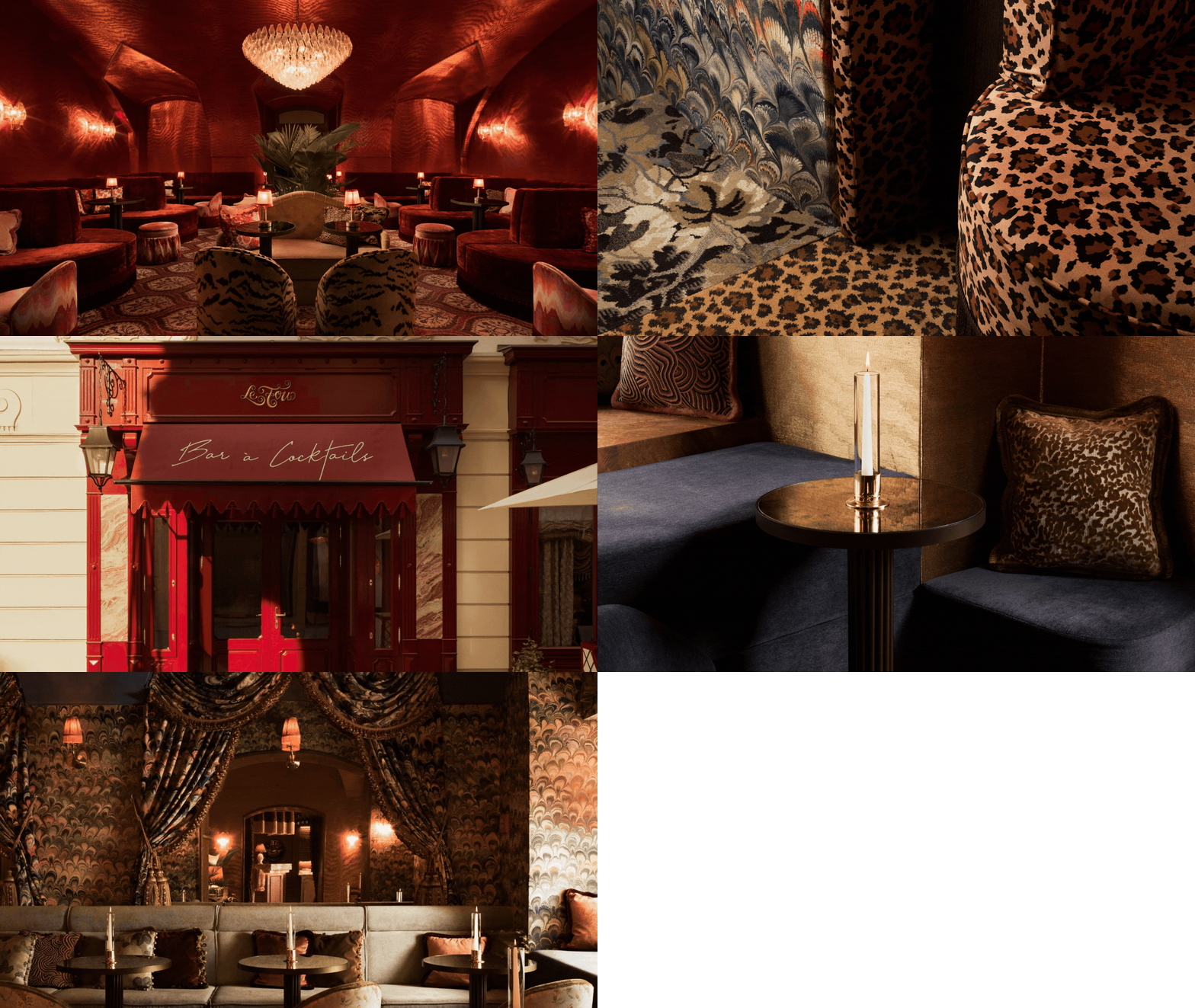
Forget minimalist listening bars designed to bear no sign of decor other than their color-drenched neutral walls: in romantic Vienna's First District, a new moody cocktail bar is challenging the stripped-back look of Europe's coolest nightlife spots through plush patterned fabrics, shimmering lighting, and a rabbit-hole-like journey through intentionally contrasting textures, rich materials, and colors.
An experiential manifestation of the saying "more is more", Le Fou brings back old-school glamour and grandeur, recasting it for the style-discerning bon vivant and keeping shabbiness in check. Ask us, and we'll confirm: we're obsessed. Opened last December, Le Fou unfolds as a series of four interconnected rooms anchored by a central stone bar and located in one of Vienna's most charming neighborhoods, and is the work of London-based Austrian designer Theresa Obermoser.
She imagined the sprawling cocktail destination for owner Alexander Schrack in less than 12 months, having first received a call from the entrepreneur while she was still in the hospital recovering from giving birth in January last year. As Obermoser took to Freisingergasse 4, the location was born again, too — not by sticking to dominant trends, but by setting an aesthetic of its own.
Move Over, Trends: Le Fou Is Here, and It's Not Afraid to Experiment

"The client wanted a layered, intimate, and characterful environment. Crucially, Alexander wanted every room to tell its own story, almost as though each had its own main character — and my job was to translate those characters into design." — Theresa Obermoser
Obermoser intentionally kept away from the biggest interior design trends to foreground a layered look where each element of the scheme "have presence while forming a cohesive whole". The same principle also applies to the venue itself: "Alexander wanted every room to tell its own story, almost as though each had its own main character," she says. "My job was to translate those characters into design."
Heavy with drama, the result is part Paris at nighttime, part London private members' club, with densely draped curtains revealing each ambience "one by one, rather than a single monolithic room".
"The decision to give every room its own personality — its own wallcovering and palette — and let the bar do the work of connecting them expresses our belief that interiors should be experiential and emotionally distinct, not uniform," adds the designer.
Again, this goes against the airy schemes we have seen trending over the past few years, where walls were knocked down, and spatial divisions vanished to embrace continuous home environments, an outdated living room layout trend that's now being reversed by using separation to create a sense of intimacy, comfort, and surprise.
Each Room, Its Look: Behind Le Fou's Environment-Specific, Progressive Scheme

"The biggest challenge was the timeframe — everything else is what we do; it's the job. Coordinating Austrian craftspeople with international fabric and wallpaper houses on a one-year program was the real test." — Theresa Obermoser
Across Le Fou, curated art is replaced with bespoke wallcoverings, and abstract motifs set the mood for every individual space. To put it in Obermoser's words, here, "the architecture itself is the canvas", and each of the four rooms boasts its own standalone color story.
In the Main Room, alive with the same rusty tones of London's premium jazz club Upstairs at Ronnie's, and wrapped in striking moiré wallpaper by Arte, guests are welcomed in the most sensational of ways — staggering Murano glass chandeliers, velvet red banquettes, and an aura of spectacle.
A jewel-like atmosphere awaits inside the Blue Lounge, where an Arabian-blue palette is balanced off by glossy and matte brass, and with textured wallpaper and romantic drapery by Beata Heuman.

A leopard-heavy detail of the Leopard Room, the most photographed room in the whole cocktail bar, wrapped from floor to ceiling and walls in soft Pierre Frey textures.
Even more opulent and eccentric is the Golden Lounge, possibly the most daring and 'transitional' of all four rooms — an irreverent mix of heritage and contemporary influences distilled across cocooning olive green seating, Art Deco lighting, navy accents, and lacquered surfaces, with Lizzo's peacock-pattern fabric and theatrical curtains bringing it all together.
Last but not least comes the Leopard Room, the most exclusive space in the house, serving as Le Fou's coveted retreat. Its floor-to-ceiling (and walls) Pierre Frey leopard print, fluted glass ceiling lamps, and punk stone tables aren't for the faint-hearted, but even then, "they're the most photographed corner in the whole bar," reveals Obermoser.
The Balancing Act: Lean Into a Sense of Bravery

A jewel-like atmosphere awaits inside the Blue Lounge, where an Arabian-blue palette is balanced off by glossy and matte brass, and with textured wallpaper and romantic drapery by Beata Heuman.
The list of manufacturers that contributed to the project is almost as eclectic and varied as Le Fou's kaleidoscopic atmosphere, from textile pioneers Dedar and Ege Carpets to bespoke furniture makers Leta and Topos Workshop, curtain and cushion artisans Raumgestaltung Thomas Albrecht GmbH & Co KG, and bespoke joinery and built-in seating by Landeka Massmöbel GmbH, among others.
"Coordinating Austrian craftspeople with international fabric and wallpaper houses on a one-year program was the real test," Obermoser confesses. Without them, Le Fou wouldn't have turned out the vibrant mosaic of interior inspiration it is today. Recently featured in the prestigious Prix Versailles World's Most Beautiful Restaurants list, this riveting spot is a reminder that, unlike bravery, trends alone won't get you far.
Get the Look

Curious to see how theatrical drapery might work in a home setting? Revisit our home tour of Kristina Busko's spectacular Spanish apartment project for a step-by-step guide on how to style it in your own space.
Feel as though you need more guidance? Read about how textile artist Mia Sylvia embraces fabric to capture the emotional essence of her surroundings, or browse our curated shopping buys for an extra decor spark.

Thinking of testing out a more maximalist look? Proceed with caution. A cushion, a pair of curtains, or an extravagant rug can all help you warm up to a more layered scheme without feeling overwhelmed. This Soho Home peacock-inspired patterned cushion makes for a great start.

Perfect to bring Le Fou's golden-y warmth to your living room and corridors without having to redo entire rooms, these textured sconces from La Redoute will make every night the right night for some good-old candlelight.

I am with you: leopard print isn't necessarily the easiest fabric to style, particularly if you fear regretting your choices over time. This sculptural, fun arm chair by Cult Furniture remedies that with its abstract pattern. Somewhere between the old-style seating of Le Fou and a chunky piece of furniture like the one trending today, it will anchor your living room from the moment it's gone through your door frame.
And if you can't get enough inspiration, sign up for our newsletter for more.
