Spikes, Acid Colors, and Chairs You Can't Lounge On — How 'Discomfort' Became One of 2027's Biggest Design Trends
"A room only becomes interesting when not everything in it is trying to please you"


This article appears in Style Pulse for SS27, the biannual report identifying the biggest interior design trends for the upcoming season.
Read the rest of the Style Pulse trend report, now.
I have a feeling that the ‘quiet luxury’ moment was a turning point in how we feel about our homes. If you missed this trend the first time around, the long and short of it was an ideology that elegance doesn’t shout; it whispers. In interiors, it translated into homes that were neutral and soft, yes, but also inherently inoffensive and safe… words that have come to have a not-so-desirable meaning today in design.
But where quiet luxury felt, above all else, ‘comfortable’, in just a few short years, something has changed in the zeitgeist. Designs are emerging that don’t just ‘shout’, but introduce elements that seem to deliberately challenge our expectations of how a home should behave — rooms that feel slightly jarring, even if just for a moment.
The word I’ve come to use to describe these ideas is reactionary against the trends that came before: it’s ‘discomfort’. But, maybe ironically, it’s not a word that I feel most interior designers I speak to about it are, well, comfortable with.
I don’t think ‘discomfort’ means the same thing as ‘uncomfortable’, though. Discomfort is a slight wince; a momentary squirm — something that challenges and pushes your boundaries. “I’d say friction rather than discomfort,” designer Nicholas Kaiko, founder of Kaiko Design Interiors, pushes back on me as an alternative. Friction is a word that has come up a lot, independently, across our interior design trend report for 2027, but the reason I love discomfort is that it’s a more recognizable feeling to me.
Yet, whatever we call it, it’s clear we’re talking about the same thing. “What keeps a space evolving is one or two elements that don’t quite settle,” Nicholas says. “A color that’s slightly too loud, a surface you want to touch but aren’t sure you should, or a piece of furniture that seems at odds with the rest.”
“That friction can’t be random, though,” the designer adds. “It needs to be deliberate so the rest makes sense.” And therein lies the art of creating discomfort in the home.

"When balanced with deeper, more grounding colours, an acidic shade can become surprisingly soothing," says designer Sophie Rowell. "It’s all about the context in which you use it, and the way the colors relate to one another."
One of the most interesting ways in which discomfort, or friction, is being realized in the most exciting interior design projects today is through decorating with color. “We’ve spent so long trying to create interiors that are harmonious, cohesive, and universally pleasing, but I think there’s a growing confidence in allowing a space to be a little more unexpected,” says interior designer Sophie Rowell, founder of design studio Côte de Folk. “People are becoming more comfortable expressing their individuality rather than following a prescribed idea of what a home should look like. There’s a freedom in that, and a willingness to trust your own instincts rather than worry about whether something is conventionally tasteful.”
Palettes that challenge convention, that feel like they don’t make sense on paper, and that could feel harsh and jarring to live with, are being used to create spaces that feel anything but.
Take, for example, a recent project of Sophie’s, pictured above, created for the youngest client she’s worked with to date. “In this bedroom, the chartreuse and deep purple are certainly an unexpected pairing, but what I find particularly interesting is that, despite their visual impact, the room feels incredibly calming,” the designer says. “The colors have depth and richness, and there’s something enveloping about the combination. It feels cocooning rather than chaotic, which is exactly what you want from a bedroom.”


The use of acidic colors, in particular, is one of those emerging trends that naturally plays into the idea of discomfort — surely, a luminous chartreuse is not meant to be easy on the eye, after all? “Acidic colors, such as chartreuse, bring a particular energy to a space,” Sophie suggests. “They have a freshness and vibrancy that can feel almost electric, introducing a tension that more conventional colors don’t offer.”
“But that doesn’t mean they have to feel loud or unsettling,” the designer adds. “For me, the secret to creating a successful, slightly ‘unsafe’ palette is to understand that contrast doesn’t have to mean conflict. You need to be willing to take a risk, but you also need to consider the balance, the proportions and the atmosphere you want to create.”

"An interior that has no tension isn't that interesting to me," says designer Leah Ring of studio ANOTHER HUMAN.
Discomfort is also being found in form, too. Soft, fluid lines have become an inescapable part of the modern design lexicon, in everything from the curved sofa to the bullnose edge of kitchen countertops. Anything that was once ‘linear’ has been re-engineered into a more curvaceous, flowing form. And, for good reason. In design psychology, we’re programmed to avoid sharp corners — rounding the edge off makes our spaces feel more welcoming and safe.
So, what can we infer from the swing of interior design trends not just from curves back to straight lines, but to jagged, pointed, zig-zagging, and even spiked edges? “Spikes are an evolution,” ponders Russell Whitehead, one half of design duo 2LG Studio, “and those soft organic shapes have solidified into harder angles.”

2LG Studio recently launched a lighting collection BRIAR with North South AD. “We took photographs of the rose bushes in our garden and used those to create spiky lighting sculptures that could be alive,” Russell explains.
Russell suggests that, much like the curves that came before, these forms take just as much inspiration from the natural world. “Plant forms that gave inspiration behind trends for biophilia and organic shapes have taken a darker turn towards something more edgy — the sharp thorns of a rose bush hold as much beauty as the soft pale petals. It’s the contrast of both that we find really exciting.”
It’s perhaps the most pointed example of deliberate discomfort in design, if you’ll excuse the pun, actively pushing back on the psychological underpinning of what makes a home feel comfortable. “Discomfort is something we are all feeling,” Russell says, “so it’s no surprise that it is appearing in the creative output of designers. Perhaps it’s a need to rebel or agitate or stand ground. Or perhaps it’s a way to make the beauty out of the challenges we now face.”
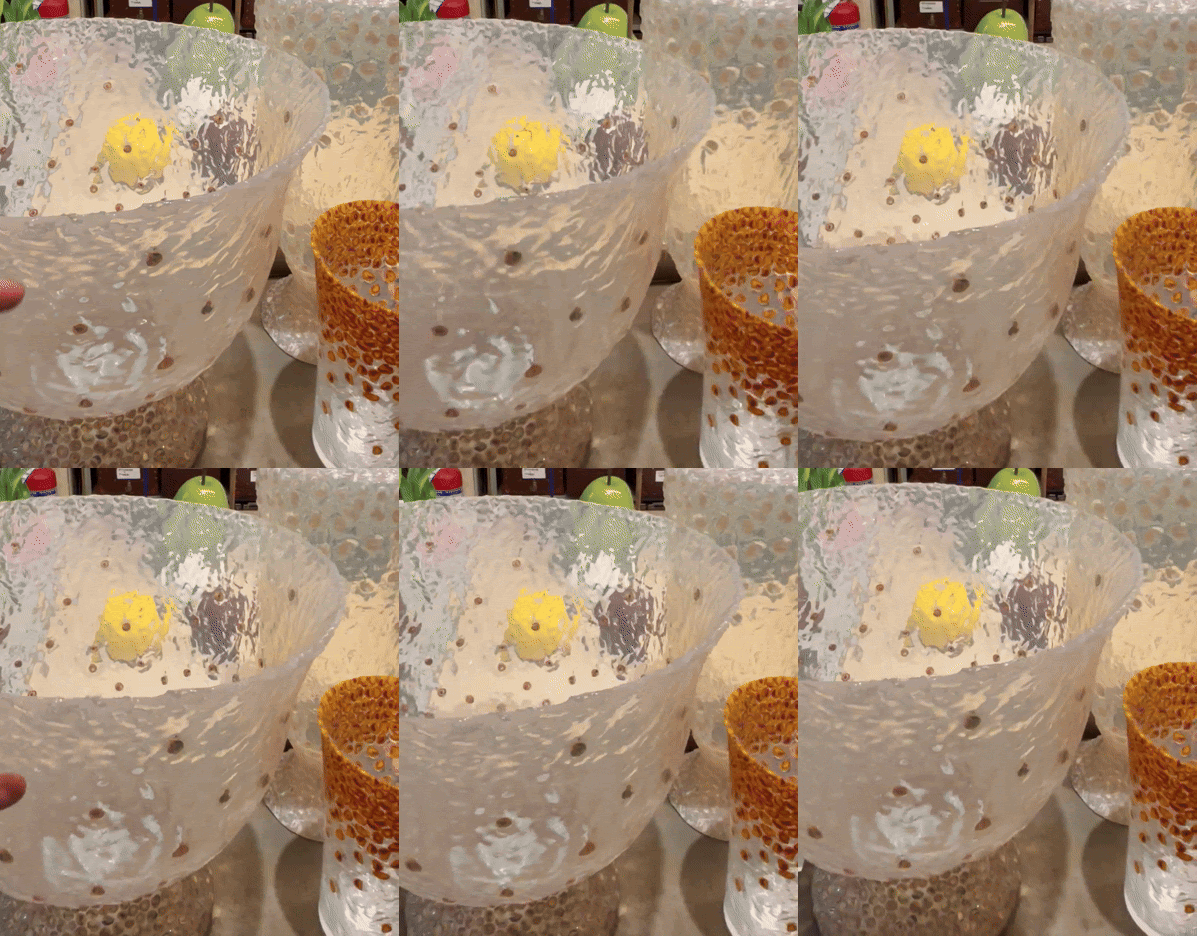
There's something brilliantly unsettling about Alessandro Ciffo's silicone vases that appear, at first, to be made from glass.
Image credit: Future

Sharp zig-zag borders and organic textured surfaces are both design signatures of Miami-based studio Moniomi Design.
Image credit: Moniomi
Other uncomfortable forms are also emerging in modern design, especially in materials that feel ‘overly textured’, or as Nicholas Kaiko puts it: “a surface you want to touch but aren’t sure you should.” At Milan Design Week this year, one of my last memories was a collection by Alessandro Ciffo at Galleria Rossana Orlandi, which looked like glass but was actually made from silicone, and wobbled when you touched it.
But, it could be anything that feels overstimulating to the touch (to somebody, at least). “There are a few textures I keep coming back to,” suggests Nicholas. “One is stone left with its pores open, like unfilled travertine. Another is playing with gloss levels, in paint or in applied finishes like veneers and spray finishes.”

"The acidic color of the art [Chrome Enigma by Tan Arlidge] sits against the rest of the palette rather than matching it and that’s deliberate," says Nicholas Kaiko. "Art shouldn’t be chosen to coordinate with the cushions. It should have its own opinion."
And, although I’ve differentiated between discomfort and uncomfortability, I can’t help but be charmed by the idea of furniture that’s not really designed only with comfort in mind.
Of course, comfort is a baseline of what we want from our homes, but not everything needs to be in pursuit of the idea of comfort, as this living room by Kaiko Design Studio goes to prove.
It may be a modern design icon, but the Tom Dixon S-Chair is not, outwardly, the sort of chair you’d gravitate to sit on to unwind after a long day in the office. “Tom Dixon’s S-Chair is there to be looked at as much as sat in,” Nicholas explains. “The sofa does the work of comfort, and the chair does the work of form.”
“A second deep, soft seat would have made the room heavy and sleepy,” the designer adds. “Something upright and sculptural keeps the eye moving, and it changes how people use the space. It’s the chair you perch on with a glass of wine while someone else takes the sofa. I’d argue most living rooms need one. A room only becomes interesting when not everything in it is trying to please you.”

"My clients expressly do not want their homes to look cookie cutter or like anything else they've seen before," says Leah Ring.
That’s to say, discomfort only works if it’s very deliberate. I think Leah Ring, founder of Los Angeles-based studio ANOTHER HUMAN, is the name to look to for someone who has mastered the art of introducing friction in this bold, adventurous way. “In the quest to create unique interiors, finding tension between colors, patterns or eras of furniture is what makes a space interesting,” Leah tells me. “There's an amount of harmony in the aesthetic discord I create — while mixing colors and design eras, I'm constantly thinking about texture, proportion, positive and negative space and the relationship between varied finishes.”
And that’s the true test. Discomfort, done well, should end up feeling comfortable for the person living in the home. “I really aim to make my interiors very comfortable,” Leah explains. “I've been very fortunate to have clients who are really interested in their homes as a unique expression of their personal taste. Most of my clients are bold and creative, which allows me to be very assertive in my design choices.”

Because, after all, this design trend isn’t just about a color, a texture, or the design of a chair. It’s about a human’s reaction to these things. Discomfort in design is, like any trend, a mirror to what people are feeling, not just an aesthetic choice. “I think there’s a wider movement happening at the moment, not just in interiors, but in the way we approach life,” Sophie Rowell says. “We’re beginning to understand that feeling uncomfortable isn’t necessarily a bad thing. Whether it’s having difficult conversations with the people we love, challenging our own perspectives, or stepping outside our comfort zone, discomfort is often where the most meaningful growth happens.”
“We naturally gravitate towards what feels safe, but if we always stay within those boundaries, we limit ourselves. I think we should embrace that feeling of uncertainty a little more, both in our spaces and in our lives. It’s an opportunity to grow, evolve, and discover something about ourselves that we might not otherwise have found.”
You can read the rest of our Style Pulse trend report online, now.
