From NikeSKIMS's Otherworldly Pop-Ups to Alain Ducasse's Le Dalí, Harry Nuriev Is the Designer Making the Familiar Uncanny — And Paris Into His "Stage"
As a new immersive installation by the prolific creative unveils at Le Meurice for Paris Art Week, we sit down with the talent to explore where his philosophy of "transformism" is taking him

Most creatives believe developing a signature language is the ultimate recipe for success. Russian-born, Paris-based architect and designer Harry Nuriev isn't one of them. His retail and residential projects, furniture releases, and pop-up installations all embody the same vision, a philosophy he calls "transformism": the belief that the most interesting ideas often emerge not from creating something entirely new, but from looking at what already exists differently. And looking differently is exactly what Nuriev, named Designer of the Year 2026 by Maison & Objet this January, has been doing for just over a decade since the launch of Crosby Studios, the multidisciplinary practice he has been growing between Paris and New York in a continuous dialogue between design, fashion, and hospitality.
A transparent-vinyl couch stuffed with unsold, damaged Balenciaga clothes; a wall-to-ceiling, denim-clad interior sculpted from jeans reworked into sofas, mirrors, a DJ booth, and even a home gym with matching weights; a dining set cast from discarded computer keyboards, giving office hardware a more convivial purpose and a second life at once; a humungous Jimmy Choo shoe comically bursting through the window of the brand's Miami flagship; a Louis XV settee sofa wrapped in adhesive tape, showcased as one of the centerpieces of his The Transformist Apartment at Design Parade 2025 — there are very few things that burgeoning designer Nuriev's material, alteration, and narrative-led production hasn't reimagined yet.

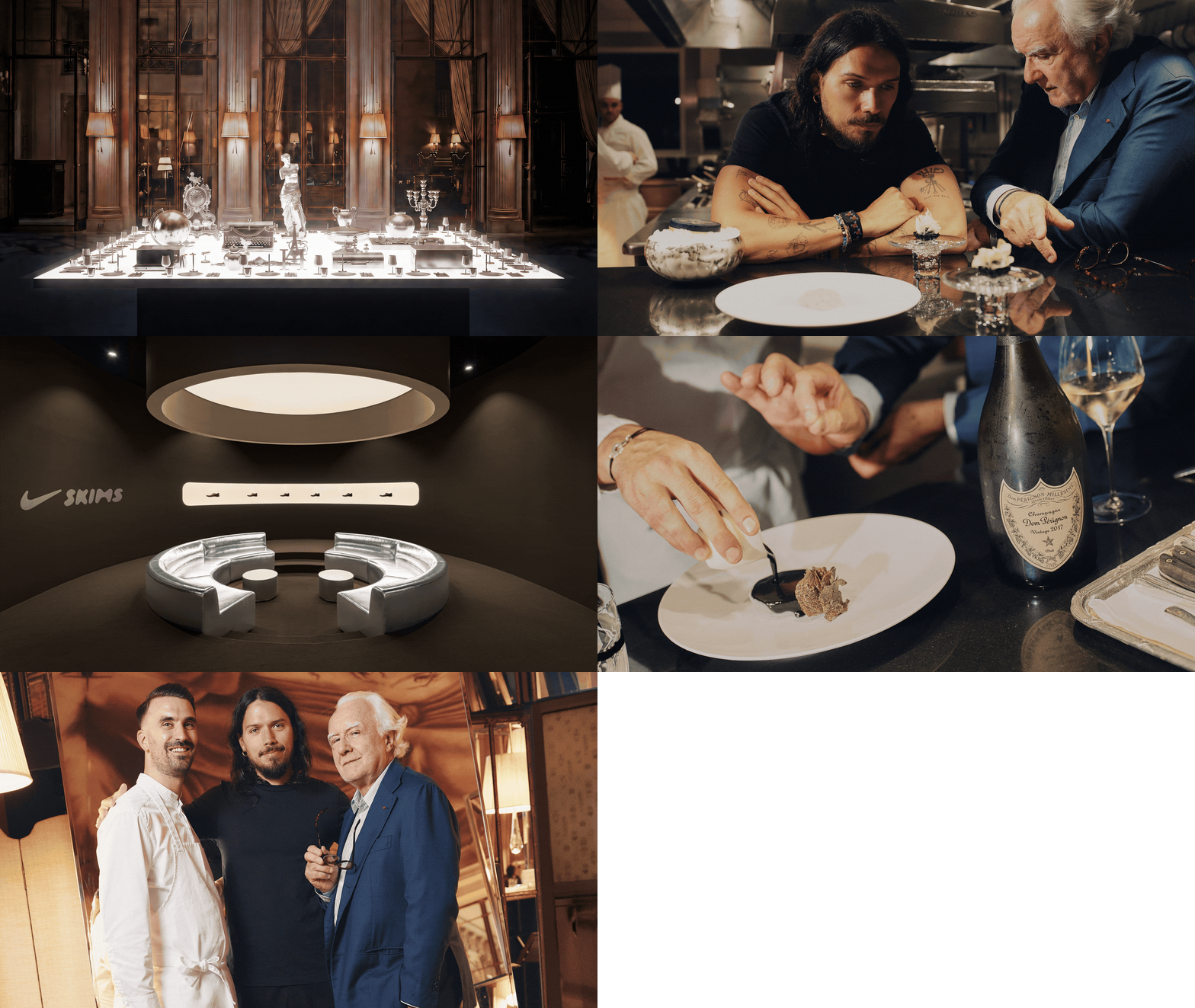
A preview look at The Stage, an installation taking over hotel Le Meurice's restaurant Le Dalí during Art Basel Paris, marking the return of Paris Art Week.
The otherworldly, soft-industrial aesthetic of Kim Kardashian's latest venture into activewear, NikeSKIMS, and its temporary stores in Le Marais, Tokyo, and Shanghai are among the latest entries on Nuriev's CV. In time for Art Basel Paris (October 23-25), the powerhouse is back with more news and work this week: The Stage is an immersive takeover of Restaurant Le Dalí at palace hotel Le Meurice, transforming a dramatically lit, monumental communal table into a cabinet of curiosities dotted with molten silver-coated, classical as well as contemporary belongings. A collaboration with in-house chefs Alain Ducasse and Amaury Bouhours, the space will be activated throughout Paris Art Week (October 20-25) with a ten-course, black-and-white tasting menu for just 24 guests, while working as an all-day eatery open for breakfast, lunch, and tea-time during the week, and hosting evening performances in the evenings.
The format may shift, but the intention behind Nuriev's projects stays the same: bringing people from different industries, backgrounds, countries, and corners of the world closer together. "During Art Basel Paris, visitors will have the opportunity not only to see the installation, but to interact with it, become part of it, and, hopefully, walk away with a thought, a feeling, or a certain energy that they can bring back into their lives. For me, this is what makes the work meaningful: becoming part of the cultural environment of Paris, while continuing to build and connect our community." Below, the designer helps us trace the evolution of his creative approach, delving into some of his most exciting projects to date, how he got here, and where he is heading next.

Designer Harry Nuriev, photographed alongside esteemed chefs Alain Ducasse and Amaury Bouhours, his collaborators for this new pop-up activation at Le Meurice.
You've said that true luxury is something money cannot buy. What does luxury mean to you today, and how does your practice incorporate that?
"For me, luxury is about bringing people together, creating space for genuine conversations, meaningful interactions, and simply enjoying quality time. I also believe that silence, peace, and reconnecting with nature are equally important forms of luxury. I always try to bring this feeling into my work, even when creating projects in the middle of a busy city."
For you, the history of art and design unfolds as a spiral rather than a straight line. When did you realize that transforming what already exists was more interesting to you than creating something entirely new?
"At some point, I came to understand that convincing yourself you're creating something entirely new is almost a form of self-deception: things don't simply repeat themselves; they evolve from one another. Accepting the idea of layering, reinterpreting, and transforming what already exists became much more interesting to me.
"I've always loved archives and been fascinated by history. Today, we have access to an extraordinary amount of historical knowledge and references, available in museums, books, and archives all over the world. For me, this is an incredible creative resource. I'm much more interested in bringing new life to forgotten corners of art history, or even to things so familiar, so visible, that people have stopped noticing them altogether. This process leads me to ideas I could never have discovered when I was trying to reject everything old and focus exclusively on creating something new or imagining the future. Today, building a bridge between the past, the present, and the future is infinitely more exciting to me."

A glimpse inside Kim Kardashian and Harry Nuriev's co-envisioned NikeSKIMS SHANGHAI temporary flagship, designed to celebrate the brand's arrival in the country.

Harry Nuriev and Kim Kardashian, photographed at the unveiling of the NikeSKIMS CAFE in Tokyo, Japan.
From the Balenciaga Sofa to your Denim Furniture Collection and NikeSKIMS collaborations, your work moves fluidly between fashion and design. What interests you about bringing these worlds together, and where do you see the boundaries between them disappearing?
"For me, there are no real boundaries between different creative disciplines. What matters is the pure act of creation, an idea that comes to me and that I feel an irresistible desire to bring to life. With projects like the Balenciaga Sofa or my Denim Furniture Collection, I simply wanted to express the idea that what we wear on our bodies can just as easily become part of the furniture we live with. Furniture is an extension of our lives, our taste, and our everyday needs, just as clothing is. And in the same way, I believe that works of art can become a natural part of our everyday lives, rather than something separate from them."
Your Art Basel Paris 2025 installation Objets Trouvés, hosted at Beaux-Arts de Paris's Chapelle des Petits-Augustins, turned the church into a living marketplace of exchange where visitors could trade unwanted objects for items left behind by someone else. What fascinates you about the stories and invisible histories objects accumulate, and how does changing their context alter the way we see them?
"I have very little tolerance for display cases, for the accumulation of objects, and for many of the conventions that shape our everyday surroundings. I often find beauty in things that others might consider completely unremarkable, while sometimes feeling incredibly bored by objects that are celebrated as masterpieces of perfection. This imbalance comes naturally to me. I don't force it or try to turn it into an artificial statement. It's simply the way I see the world. That's why my installations — where I bring objects out of oblivion, things that were gathering dust just yesterday — and place them in a completely different context, whether a museum or a gallery, feel entirely natural to me. For me, this process is as instinctive as a pen, a pencil, or a computer is to a writer."

Throwing it back to one of the designer's most thought-provoking creations: the Balenciaga Sofa (2019).
Your work questions consumerism even as it involves creating new objects and increasingly ambitious installations. How do you navigate that dichotomy, and what does a more conscious relationship with the things we own look like to you?
"On one hand, of course, I create things and help my partners and clients develop increasingly ambitious installations and projects that attract more and more attention. On the other hand, I'm constantly questioning consumerism. I think this contradiction brings us to a much more important question. There is absolutely nothing wrong with rewarding ourselves with beautiful things, enjoying them, or surrounding ourselves with objects that bring us pleasure. But I believe we should be more conscious of why we consume. The problem isn't consumption itself, but the moment it becomes automatic, when we stop questioning what we buy and why we need it."
"Isn't it beautiful that we can exchange objects without any financial transaction? Something you no longer need might be exactly what someone else has been looking for. And something another person can't wait to get rid of might find its perfect place in someone else's home. What fascinates me about this exchange is that it's not a selfish act of getting rid of something old to make room for something new. There is also an incredible, invisible connection between people. Objects carry stories, memories, and a certain energy from their previous owners. And when we exchange them, we are passing a little piece of ourselves to someone else.
"I find something deeply philosophical in the idea that everything entering our home absorbs a part of our energy, and that this energy never completely disappears. When an object moves into another space, it begins to absorb another person's life, another history, another energy. Over time, objects accumulate these invisible layers of everyone who has lived with them. There is something incredibly beautiful, and also quite ironic, about it."

Installation view of Harry Nuriev's Objets Trouvés installation, unveiled last year in Paris's Chapelle des Petits-Augustins as part of the Art Basel Paris calendar.
For The Stage at Le Meurice's Le Dalí, you've brought sculpture, light, gastronomy, and performance together in a space shaped by Salvador Dalí's surrealist legacy. How did you approach transforming this historic setting, and what did you want the installation to make possible that a conventional dining experience could not?
"Paris has so many layers of extraordinary history. Some are hidden, almost secret, while others are right in front of us, part of everyday life. With this project, I wanted to take something familiar, something with history, and give it an unexpected twist. In this case, I was thinking about a stage, a dance floor, something that could suddenly become a dining table or a platform for an art installation. Paris itself is a stage for so much of what happens in culture around the world. I wanted to see how that idea could be transformed into a single object.
"The Stage is inspired by the academic understanding of sculpture and installation, but I also see it as something with its own energy and personality, something that lives alongside us throughout the day. Who knows what it might be thinking, or what new idea it might bring? I wanted this installation to exist not only through its physical form and light. Light has become one of the most exciting new materials for me to explore in my work. The platform itself is already a statement. It is a stage for objects, a stage within the space, a stage for performance, and eventually, a dining table within a single structure.

"When an object moves into another space, it begins to absorb another person's life, another history, another energy. Over time, objects accumulate these invisible layers of everyone who has lived with them. There is something incredibly beautiful, and also quite ironic, about it." — Harry Nuriev, founding designer of Crosby Studios

Installation view of Harry Nuriev's The Stage, as seen at the Alain Ducasse-helmed restaurant Le Dalí at Le Meurice, Paris.
"The accumulation of objects is particularly important to me, as it continues the ideas I explored with Objets Trouvés, which I have continued developing in my work ever since. What fascinates me is that objects that were considered useless yesterday can become part of an artwork today without being physically altered at all. This can happen simply by changing their position, context, or how we look at them. I believe every object deserves the possibility of being itself and, at the same time, being considered art. Especially in a world where we often assume that creating art requires making something entirely new from scratch. And of course, this brings me back to two of my greatest artistic inspirations, Marcel Duchamp and Andy Warhol."
You've reimagined everything from discarded clothing and scrap denim to digital realities. What is one medium, industry, or concept you haven't had the chance to explore just yet, but are incredibly eager to dive into?
"I'm very interested in cinema, theater, and ballet. I find it fascinating how, in just two hours, a person can experience so many emotions, question so many things about life and the future, and almost live an entire lifetime through the characters on stage or screen. The idea that an artistic experience can take you through so many different lives, feelings, and perspectives in such a short amount of time is incredible to me, and I believe this would be a very interesting and unexpected medium for me to explore in the future."


If you're a fan of Nuriev's work for NikeSKIMS, wait till you see how he turned a formerly deserted corner of East London into an ever-evolving restaurant interior with our review of the chrome-tinted Noisy Oyster.
Got your Art Basel Paris and Paris Art Week itineraries sorted? Make sure to check back in on Livingetc's lifestyle stories for weekly updates on all the hottest hospitality openings and culture and film releases, and get them sent straight to your email by joining our newsletter today.
