Is Taste Dead? We Asked 4 of London's Most Exciting Creatives to Unpack Our Obsession With the 'Hyper-Curated' — They Didn't Hold Back
In an age saturated with aesthetics, where perfected looks and mood boards can be achieved off a screen, people are done with surface-level presentation

There was a time when taste — an individual's inherently subjective discernment of anything good, appropriate, or beautiful in food, behavior, or the arts, from design and music to fashion, and their ability to not only acknowledge it but also interact and respond to it just as impressively — was something earned, ageing and evolving with you as you progressed through different stages in life. It was, then, a shape-shifting portrait of what you rated, valued, most, ineffable and unrepeatable as such. Now, with social media granting people a platform and, with that, a temptation to build an algorithm-dictated version of themselves, that time is gone, and taste within everyone's reach. Seemingly, at least.
The year is 2026, and you don't have to window-shop or, 'worse', spend hours trying on different clothes, to know what needs adding to your wardrobe. Instead, you can Google Lens it straight from [insert X influencer name]'s Instagram grid. On the most next-gen e-commerce websites, you can even get an idealized virtual avatar of your likeness to give the outfit the first spin before you proceed to add it to your cart. *Sends screenshot to friend*: "What do you think?"
Weight-loss injections Ozempic and Mounjaro are shrinking bodies worldwide back to 1990s, size-0 standards, while digital filters and AI-manipulated imagery, along with appearance-enhancing phenomena such as Looksmaxxing, Baby Botox, and wider cosmetic procedures appealing to an ever-younger crowd, all contribute to making formerly unattainable beauty canons more desirable and purchasable. Except beauty itself, much like taste, has begun to fade. Not in its internet-shared, increasingly homogenizing representation, of course, but as a quality and a pursuit innate in people, unregulated and uninfluenced by platforms and tailored ads telling you what you should like — *read: buy* — and look like — *read: also, buy*. That, to many, is the hard truth of the current zeitgeist.


"Everyone wants to be chic, cool, and intellectually sexy. But what if actually being cool was defined by a life unaffected by algorithms?" culture platform Impact's associate editor Nardos Haile wrote in an Instagram carousel earlier this month. With my antennas up as I researched this piece, I couldn't help but agree. "As digital natives, we are too accustomed to a life built in an algorithmic silo where our opinions aren't our own, our sense of personal style is from a curated guide on how to be a cool girl, and our filmography echoes what movie people are thinkpiecing to death online," Haile continued. "We once had taste forged from our own distinct personal preferences. Now, we've reached a point in the digital age where everyone seems to be a curator of taste without the lived individual experience outside of the algorithm."
A great deal of this stems from everyday fatigue: aesthetics-rich but money- and time-poor in a global cost of living crisis, we find ourselves treating picking our next decor or fashion buy, or planning our next holiday or home renovation — what would have once been considered stress-free, leisure activities — as the next time-pressured chore to tick off our work to-do list. Not even spending time with friends and loved ones has been spared.

"The death of hosting, the loneliness epidemic and the fact that everyone's home but no one's coming over, is the depressing result of late stage capitalism," Panayiota Soutis wrote in a new post on her thought-provoking culture and food Substack, The Goal is to Eat, this week. She argues that what's particularly interesting about that shift is that it coincides with "the rise of hosting-as-performance, both as online content and exclusive brand events," adding that "gathering to nurture 'community' is now in the hands of companies over individuals."
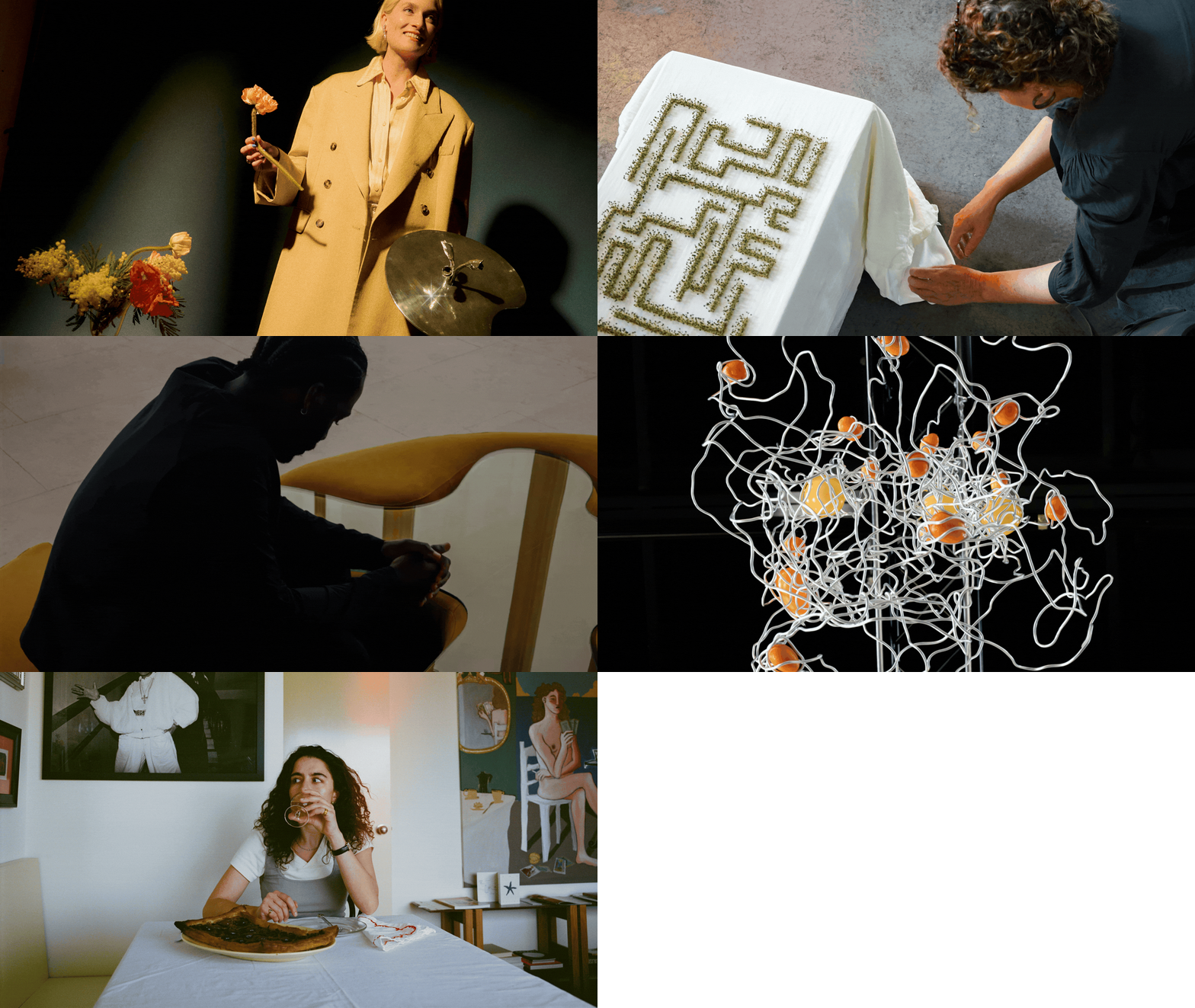
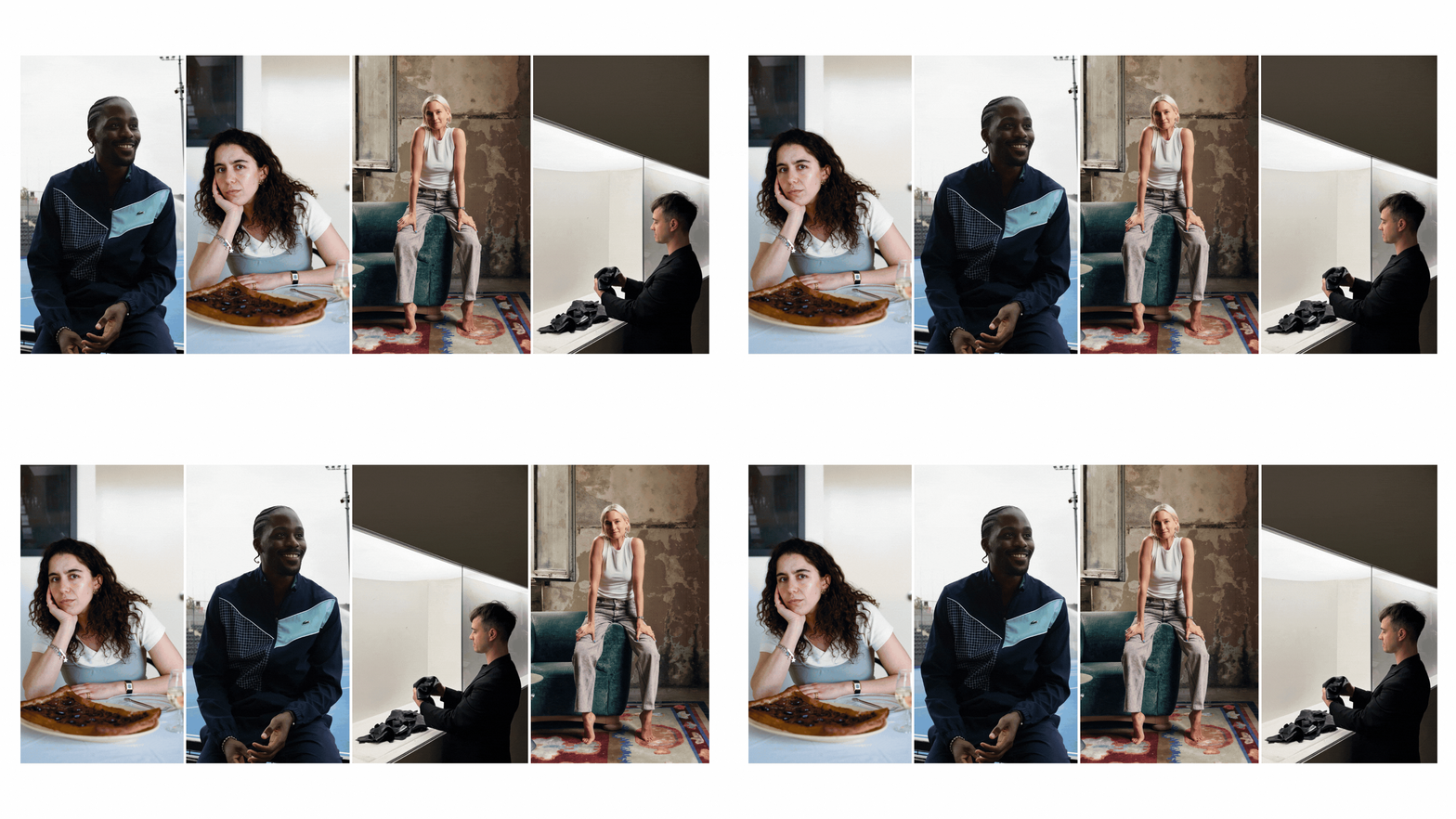
Fittingly, if somewhat ironically, that shift, and where the business of taste — design, the arts, and gastronomy — is heading next, is what Soutis just got to explore in depth in The Future of Taste, a panel discussion I moderated this Thursday on behalf of Livingetc for Frieze's membership programme Frieze Connect, marking the return of the annual Frieze London and Frieze Masters fairs (through October 18) to Regent's Park. Held in the Willow Room of Aethos London Shoreditch, the roundtable featured Studio Ashby's founding designer Sophie Ashby, visual and music artist and designer Emmanuel Lawal of Forestalgia, and Soutis herself as panelists, and was accompanied by a bespoke food installation conceived by Food Art Fair and food design studio Maisongb's founder, Giuseppe Burdo, in collaboration with the venue's executive chef Aaj Fernando. Turns out, taste might not be dead after all: scroll to discover how each keeps it alive and make it their own below.


Emmanuel Lawal, Designer, Visual and Music Artist, Founder of Forestalgia
What's One Thing You Remember Loving Instantly as a Child That Still Shapes Your Taste Today?

"I've always been drawn to things that felt considered but slightly unexpected. As a child, I remember being fascinated by footwear — not just the shoes themselves, but the idea that something functional could also say so much about you. Color, proportion, material, the way something ages: I've carried that curiosity with me ever since."
If Your Taste Could Have a Scent and a Flavor, What Would Those Be?
"The scent would be something woody, warm, and slightly smoky — cedar, leather, maybe a little incense. The flavor would be something much brighter: citrus, chilli, herbs, a little bitterness. I like contrast. I'm rarely drawn to things that feel too perfect or singular."
Who's One Tastemaker You Look Up to Daily That You'd Love to Sit Next to at a Dinner Party?
"I would have loved to sit next to Virgil Abloh. His ability to move between fashion, architecture, music, art, and culture without treating them as separate worlds was extraordinary. More than anything, I'd want to understand how he saw connections between things that other people might not have put together."
Is Taste ... Inherent, Purchasable, or Cultivated?
"Taste is cultivated. You might have an instinct for certain things, but taste develops through exposure — traveling, listening, looking, touching, eating, making mistakes and changing your mind. You can purchase beautiful furniture, art, or clothes, but you can't purchase a point of view. Someone can fill a room with the most desirable pieces in the world, and it can still feel completely disconnected from who they are. Equally, a home filled with second-hand objects, family pieces, and things discovered along the way can feel incredibly sophisticated because there's a story and sensibility behind it. The same applies to fashion, music, and art. Taste comes from developing a relationship with culture rather than just consuming it."


What's One IRL Experience You'd Never Trade for a Screen? Which of Your Senses Are You Most Driven by When it Comes to Judging the Tastefulness of Something?
"Conversation around a table. You can't replicate the feeling of sitting opposite someone, sharing food, hearing their stories and having a conversation that takes an unexpected turn. There's something very human about that exchange. I'm probably most driven by touch. As a designer, I'm constantly thinking about materiality — how something feels in your hand, how a surface catches the light, how leather ages, how a chair feels when you sit in it. Something can look beautiful on a screen, but the physical experience can completely change your relationship with it."
Art, Design, Food, and Fashion Are Suddenly Sitting at the Same Table: What Stems From That Contamination?
"I don’t think they were ever really separate. We just became accustomed to putting them into categories. The most interesting creative work happens in the space between disciplines. A chef thinks about composition like a designer. A fashion designer thinks about material and form. An artist thinks about atmosphere. A designer thinks about how people move, gather, and interact. When those worlds collide, you get experiences rather than just objects. That's where a lot of the excitement is happening now."
Where Does Community Sit in This Mix — And What's the Importance of It?
"Community is what gives these disciplines meaning. Without people, culture becomes purely aesthetic. When you bring different creative worlds together, you create an environment where people can exchange ideas, discover something outside their usual field and form relationships that probably wouldn't happen otherwise. The best events don't feel like networking; they feel like people genuinely sharing a moment. That sense of connection is something I think about a lot through Forestalgia — creating spaces and experiences where people can connect, converse, and create."
What's One Anecdote You Cherish To This Day From One of Such Events?
"Some of the most memorable moments for me have actually been the things that weren't supposed to happen. At one of our gatherings, what I remember most wasn't a particular celebrity or perfectly executed moment, but the point where everyone stopped behaving like they were at an event. People were sitting around, talking, laughing, moving between conversations and genuinely connecting. Someone spilt something, plans changed, people arrived late — all the normal human things. Those imperfections are often what you remember. We spend so much time trying to create polished versions of ourselves, but the moments that stay with you are usually the ones where the polish disappears."

Image credit: Courtesy of the artist

Image credit: Courtesy of the artist
Tell Us About One Object, Piece of Furniture, or Artwork That Best Captures Your Vision of Home.
"For me, it would be Modular 001 by Forestalgia, the first furniture piece Forestalgia developed as a studio project. I wanted to challenge the idea of furniture as something that simply occupies space. Modular 001 was designed around the ideas of connect, converse, and create — bringing together the functions of a table and a chair, with integrated lighting and sound, to craft a more immersive social experience. The inspiration came from thinking about how we actually use our homes. The most meaningful moments rarely happen in isolation; they happen around a table, on a sofa, over music, food or conversation. So rather than designing a piece around a particular room, I designed it around the moments that happen within one. In many ways, Modular 001 represents how I think about home: not as a collection of beautiful objects, but as a space that facilitates connection. The furniture is there to support the life happening around it."
Today, Storytelling Is Yet Another Pillar in Our Homes. Where Does This Hunger for Stories Come From?
"I think it comes from wanting things to feel meaningful again. We're surrounded by an incredible amount of visual information, so simply having something beautiful isn't always enough anymore. We want to know where something came from, who made it, why it exists and what it means. The room I find most inspiring is the living room because it's usually where different parts of someone’s life collide. Books, music, furniture, art, objects from travels, things inherited from family — it becomes a kind of autobiography."
In an Age of Scarcity, Culinary Pop-Ups Mustn't Ignore Waste. How Can Chefs Combine a Creative Approach to Gastronomy and Sustainability?
"I think the future will be less about making food look impossible and more about making the experience around it feel memorable. A beautifully made piece of bread, a perfect tomato, a dish that reminds you of somewhere or someone — those things can be more powerful than something designed purely to photograph well. The most sophisticated experiences often have a very simple core."
The World Is Burning. You Have 5 Minutes to Escape on a Spaceship and Can Only Take One Thing With You. What Does That Item Tell Us About You?
"If I were leaving Earth forever, I wouldn't want to take something that simply tells me what things looked like. I'd want something that reminds me how life felt. I'd take a dining chair. Not because it's the most valuable object I own, but because it reminds me of something very human: sitting around a table with other people. Before everything became so fast and screen-led, we would sit down together, eat, talk, listen, argue, laugh, and simply be present with one another. A chair represents that possibility. Of sitting down. Of having a conversation, eating, thinking, listening, or simply being present. For me, that's what good design should do: hold memories, facilitate human interaction, and remind us to imagine."

Panayiota Soutis, Founder of The Goal is to Eat
What's One Thing You Remember Loving Instantly as a Child That Still Shapes Your Taste Today?

"Beads! Jewellery! Embellishment! Patterns: tracing them, spotting them. Shells! Stones! Red things. Textures. Always observing the details."
If Your Taste Could Have a Scent and a Flavor, What Would Those Be?
"Vanilla and rose, cinnamon and tobacco."
Who's One Tastemaker You Look Up to Daily That You'd Love to Sit Next to at a Dinner Party?
"Brenda Weischer AKA Brendahashtag."
In an Age of Scarcity, Culinary Pop-Ups Mustn't Ignore Waste. How Can Chefs Combine a Creative Approach to Gastronomy and Sustainability?
"Totally. I see us returning to the basics, stripped-back simplicity. From events to restaurants, the impact of nostalgia — looking back to move forward — will see us opting out of complexity, toward less stimulation and more purity. But at the same time, with an injection of entertainment, of lightheartedness, fun first."
Food Has Become Omnipresent in the Arts. What Do This Kind of Banquets Bring to the Table — And What's the Detail That Gives Away a Success?
"How happy the people are to be working at them. How much of the event's design has impacted those bringing it together — are they all bought into the dream? Have they been told the story that's being told here? And are they keen to be part of this world?"

Image credit: The Goal Is To Eat

Image credit: The Goal Is To Eat

Image credit: The Goal Is To Eat
Today, Storytelling Is Yet Another Pillar in Our Homes. Where Does This Hunger for Stories Come From?
"I think everyone ultimately is on an endless journey to figure out their purpose in life, and collect things that offer stories, tell us what they're about, and why they exist. And that is captivating. Of all rooms, I find the bathroom the most interesting. It's the most intimate space, where we are most with ourselves, however uncomfortably, and it is where we take care of our bodies in the most primal of ways."
Tell Us About One Object, Piece of Furniture, or Artwork That Best Captures Your Vision of Home.
"I have a huge painting that I commissioned my friend, the painter Anouk Amount, to create for my 30th birthday. It ended up as a sort of self-portrait, full of all my favorite colors and symbols, and is representative of what I love most, from columns to a horizon, coffee to cigarettes. It is the centerpiece of our living room, and helps ground me, bringing me back to myself."
Where Does Community Sit in This Mix — And What's the Importance of It?
"Too often we forget that we're simply humans who want to feel seen and find love. Breaking down the barriers and creating spaces where interrelating industries can communicate, and interesting people can create by sharing new ideas or personal insights, will always help pull us out of ruts. Events become spaces to find common ground, to connect on mutual interests, challenge our current ways of thinking and find empowerment to keep going and growing."
Art, Design, Food, and Fashion Are Suddenly Sitting at the Same Table: What Stems From That Contamination?
"Cultural fluency as currency means that our preferences are merging into one, as proof of something. Superiority? Education? Elevation? I'm not sure anyone really knows what they're proving anymore but they want to cash in to reach a higher level."

Image credit: Alexander Simpson.

Image credit: Alexander Simpson

What's One IRL Experience You'd Never Trade for a Screen? Which of Your Senses Are You Most Driven by When it Comes to Judging the Tastefulness of Something?
"Catching up with friends and dancing. I’m driven by visuals but mostly by meaning, so really, I'm searching for the feeling that things give me."
What Does Taste Mean to You, How Does it Shape and Inform Your Everyday Life?
"Never accepting things at face value. Find out the how, ask the why. Go deeper! Interrogate, assess, observe. Paying attention to the tinier details makes all the difference. It helps us know what we like, but most of all, what we like about it."
Is Taste ... Inherent, Purchasable, or Cultivated?
"All three, but 50% cultivated, 30% inherent, and 20% purchasable, I'd say. Taste is the base; charisma, aura, intelligence, and wit all play a huge part in how tasteful you are as a person and how your aesthetic choices translate to others."
What's the First Detail You Notice in Someone's Home That Immediately Screams Good Taste?
"How much of their personality comes through in the objects they assemble. How much story is on show, how much of a world is created."

Sophie Ashby, Interior Designer, Founder and Creative Director of Studio Ashby
What's One Thing You Remember Loving Instantly as a Child That Still Shapes Your Taste Today?

"Clothes, particularly things my parents bought me on holiday. A crochet skirt from Portugal and some gold ballet pumps from Greece."
If Your Taste Could Have a Scent and a Flavor, What Would Those Be?
"My taste would smell green and earthy — tomato leaf, geranium, wet earth. And it would taste of lemon, really good olive oil, and salt. I'm drawn to things that are quite elemental: simple and familiar, but full of character. Nothing too polished or overworked."
Who's One Tastemaker You Look Up to Daily That You'd Love to Sit Next to at a Dinner Party?
"Rei Kawakubo. She connects fashion, art, retail, interiors, and culture, but most importantly has spent decades refusing the obvious answer. Dover Street Market is almost a physical manifestation of your definition of taste: instinct, curiosity, juxtaposition, and editing."
What's the First Detail You Notice in Someone's Home That Immediately Screams Good Taste?
"I'm not sure there's one object that screams good taste. In fact, if something is screaming good taste, I'm immediately suspicious of it. I notice whether the house tells me anything about the person who lives there. Their books, their art, what they've kept, what they haven't hidden away. I'm interested in evidence of a life rather than evidence of a decorator."
The World Is Burning. You Have 5 Minutes to Escape on a Spaceship and Can Only Take One Thing With You. What Does That Item Tell Us About You?
"The little pouch that houses my most worn jewelry, but I guess that's not just one thing. So, I'd go for the brown mug I bought from an old potter in Sifnos with my boyfriend. It reminds me of Kostas's calmness, slowness, wisdom. The beach at the top of the island was serene, still, and the imperfections on the mug, its largeness, and the wonky hand painted olive branch on the front will forever house its humanity. Each proves that to be magical is not to be perfect. Or, if I finally got round to actually albuming my photos, I'd take my big fat tome of a photo album."

Is Taste ... Inherent, Purchasable, or Cultivated?
"I think there may be an instinctive component, an innate sensitivity to color, proportion, or composition, but taste develops through exposure. You have to look. Visit houses, museums, exhibitions, restaurants; travel; read; watch films; look at clothes; notice how somebody lays a table. And crucially, look beyond what you already know you like. I feel like if it were an equation: taste = instinct + curiosity + editing. The editing part matters because somebody can have access to every beautiful thing in the world and still put them together badly. Money can buy beautiful objects. It can't buy discernment. And I don't think cultivation ever ends. The moment you've completely codified your taste — 'this is what I like' — you've probably stopped being curious."
What Does Taste Mean to You, How Does it Shape and Inform Your Everyday Life?
"I've become slightly troubled by the word 'taste'. Historically, ideas of 'good taste' were determined by a very narrow group of people with access, money and cultural power. So I'm increasingly more interested in discernment. For me, discernment is instinct, curiosity, and the ability to edit. Instinct is knowing when something feels right. Curiosity is looking sideways rather than always going to the obvious reference. And editing is perhaps the hardest bit: knowing when to stop, what to leave out and when to walk away from an idea you love because it isn't serving the whole."
Art, Design, Food, and Fashion Are Suddenly Sitting at the Same Table: What Stems From That Contamination?
"I'm not convinced they are suddenly sitting at the same table. They've always been there. The Bloomsbury Group didn't separate painting from textiles, furniture from food, or conversation. The Wiener Werkstätte certainly wasn't interested in those boundaries."
Where Does Community Sit in This Mix — And What's the Importance of It?
"You need people outside your discipline because otherwise you become incredibly good at talking to yourself."

Image credit: Arthur Comely

Image credit: Arthur Comely

What's One Anecdote You Cherish To This Day From One of Such Events?
"I sat next to Max Lamb at a dinner a few years ago during this time, and whilst I knew his work well, I didn't know what he looked like. I spent an agonizing 30 minutes making small talk, trying to get to know him before someone had to intervene and tell me who I was talking to politely — and stop me from embarrassing myself further."
In Interiors, One Day's Trend Is the Next Day's Old News. What Makes a Home Tasteful, Then?
"The most interesting homes contain tension. Something beautiful beside something funny. Something valuable beside something the child made. Something very old beside something almost aggressively contemporary. If everything belongs perfectly together, I start to lose interest."
Today, Storytelling Is Yet Another Pillar in Our Homes. Where Does This Hunger for Stories Come From?
"Perhaps we're craving that because so much of what we see now is frictionless and reproducible. You can buy an entire aesthetic from your phone in an afternoon. Objects with provenance, things made by people, things inherited, things collected while travelling — they resist that sameness."
Food Has Become Omnipresent in the Arts. What Do This Kind of Banquets Bring to the Table — And What's the Detail That Gives Away a Success?
"Generosity. Not spectacle. Not flowers. Not elaborate tablescaping. Can I relax? Is there enough food? Am I sitting next to someone interesting? Do I feel looked after? Hospitality is ultimately an act of generosity."
The World Is Burning. You Have 5 Minutes to Escape on a Spaceship and Can Only Take One Thing With You. What Does That Item Tell Us About You?
"I'd want evidence of having loved and been loved."

Giuseppe Burdo, Product Designer, Founder and Creative Director of Maisongb and Food Art Fair
What's One Thing You Remember Loving Instantly as a Child That Still Shapes Your Taste Today?

"The orange of grated carrots, piled into a massive volume, ready to be eaten."
If Your Taste Could Have a Scent and a Flavor, What Would Those Be?
"It would have the smell you sense approaching a fig tree and picking the fruit straight from it, and the changing scents of different ingredients as they begin to warm up, and the tang of a fresh almond before it's fully ripe."
Who's One Tastemaker You Look Up to Daily That You'd Love to Sit Next to at a Dinner Party?
"Danny Khezzar for his friendly sense of magic in the kitchen; Laila Gohar for her aesthetics; and Forniture Pallotta for the culture they build around food."
What's the First Detail You Notice in Someone's Home That Immediately Screams Good Taste?
"A sense of calm, how the light falls and reflects across the interior, the layout of the space, and the choice of objects, from furniture to kitchenware."


What's One IRL Experience You'd Never Trade for a Screen? Which of Your Senses Are You Most Driven by When it Comes to Judging the Tastefulness of Something?
"Feeling through the senses, being touched by a ray of sun, touching something as delicate as a flower, or seeing how someone's rhythm and movement can reveal much more than the eyes alone."
Art, Design, Food, and Fashion Are Suddenly Sitting at the Same Table: What Stems From That Contamination?
"They all say something about people and how we live. They're different forms of art, sometimes just using different materials. Whether as provocation or for real, they can sometimes become the same thing."
Where Does Community Sit in This Mix — And What's the Importance of It?
"It's about creating a safe place where we can share, be inspired by each other's experiences, and see things with new eyes. We all notice, learn, and approach things differently, so bringing together different materials and disciplines can make the experience more approachable and inclusive."
In Interiors, One Day's Trend Is the Next Day's Old News. What Makes a Home Tasteful, Then?
"I don't think this is only about interiors, and I don't see why we need to commit to something because of a trend. We don't change that much from one day to another. I like the idea of taste being timeless, like buying a work of art you feel you'll love for a long time. But it's also fun to love something just for a moment."

Image credit: Sophie le Roux. Courtesy of Sophie Wolf and Food Art Fair

Image credit: Sophie le Roux. Courtesy of Plate Button and Food Art Fair
Tell Us About One Object, Piece of Furniture, or Artwork That Best Captures Your Vision of Home.
"A work by Tessa Silva that I have at home. It reminds me of the feminine side of a home — gracious, but with a strong perspective. It contains milk, so you can actually smell it when you get closer, or sometimes on a humid day."
Food Has Become Omnipresent in the Arts. What Do This Kind of Banquets Bring to the Table — And What's the Detail That Gives Away a Success?
"I like to have a sense of where I am and what I have in front of me without necessarily needing someone to explain it. Then, as you get closer, the details reveal more. It doesn't need to be polished, but it needs to have an identity."
In an Age of Scarcity, Culinary Pop-Ups Mustn't Ignore Waste. How Can Chefs Combine a Creative Approach to Gastronomy and Sustainability?
"I don't think there's one way to do it. We shouldn't be afraid of using old or popular recipes that can be contextualized and elevated in ways nobody has done before. What feels familiar to one audience can be completely new to another."
The World Is Burning. You Have 5 Minutes to Escape on a Spaceship and Can Only Take One Thing With You. What Does That Item Tell Us About You?
"My backpack, so I can cheat and bring a few things with me: a knife to chop whatever edible thing I find, a blowtorch with some gas (assuming we have oxygen?), some seeds, a small plant, and, if there's still space, some water."

Keen to think more? Learn how to get your taste back in decor. Bookmark our new long-read series, The Meaning of Home, for bimonthly investigations into the topics reshaping living today, or subscribe to our newsletter to receive our full interior and cultural digest straight in your inbox.
