The Weekend Itinerary — How to Spend 48 Hours in Marrakech, According to Our Local Social Media Editor
Wondering how to maximize your time in Morocco's buzziest city? Follow our guide for the dreamy spots every self-respecting design lover should have on their radar

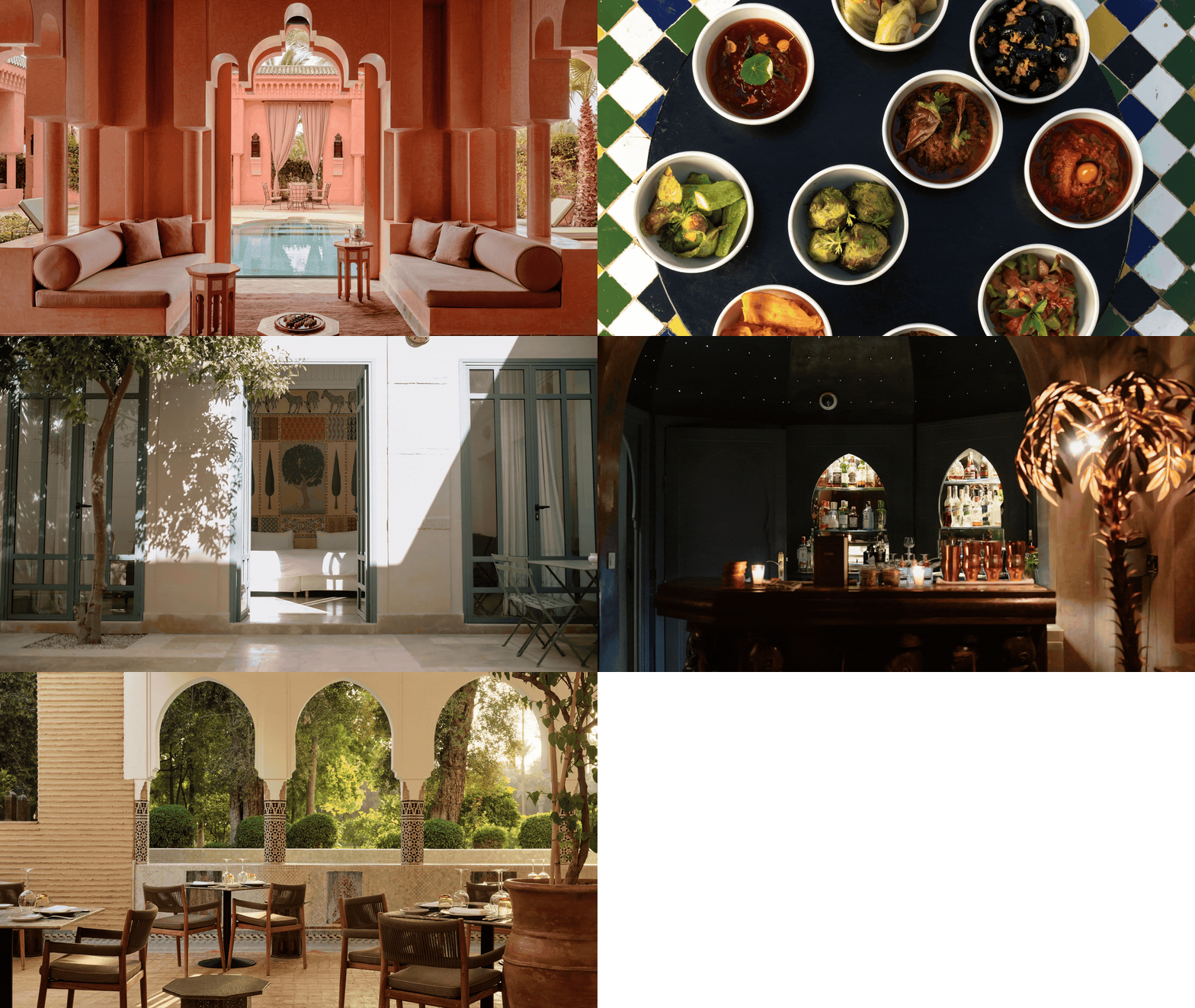
Have you ever visited a city that made you want to redecorate your entire home the moment you return? Marrakech has a habit of doing that to everyone. Whether it's picking up some pretty ceramics to refresh your tablescape or visiting hotels that'll leave you dreaming of a new bedroom, Marrakech is a design hub for anyone with a penchant for interiors. From breathtaking riad architecture to contemporary art and international design, it's one of the few non-Western cities where old meets new isn't just an expression: it's a way of life.
I was born and raised in Casablanca, and some of my favorite childhood memories involved the two-hour journey to Marrakech, a place I have always seen as close enough to home to feel familiar, yet far enough to feel like a change of scenery. Widely considered the buzziest destination in the country, and one of the world's alternative design capitals, Marrakech can be overwhelming at first, particularly for travelers experiencing it as outsiders. Its true magic, though, lies in knowing when and where to slow down, and which interiors are worth a stop in your itinerary.
Moroccan craftsmanship is alive, ever-evolving, and screaming to be experienced. That's the side of Marrakech that feels most special to me — its ability to continuously reinvent itself. Deeply rooted in the past but never stuck there, it is where Morocco's design is recast in a new light. That's what you can expect from this 48-hour insider guide: addresses that showcase the city at its best for first-time visitors or returning globetrotters, capturing how local makers' traditions, ancestral rituals, and an intimate understanding of home are finding new forms to enter the future.
What to Do in Marrakech — A 48-Hour Guide
Day 1: Check into Nobu Hotel Marrakech

Japanese calm and Moroccan heritage combine at Nobu Hotel Marrakech, and that's clear from its grand entrance.
Where: Nobu Hotel Marrakech; Nobu Riad
Begin your Marrakech journey somewhere that perfectly immortalizes the city's knack for marrying seemingly irreconcilable cultures and epochs into one. "The design of Nobu Hotel Marrakech is rooted in a dialogue between Moroccan craftsmanship and Nobu's contemporary Japanese sensibility," general manager Alvaro Sanchez says of the holiday stay, which is one of the world's leading design hotels. It sits in the Golden Triangle, a 5-minute drive to the Medina, and boasts 71 generously sized, beautiful bedrooms and suites for a One Thousand and One Nights experience, reloaded. I was particularly taken by the embossed leather details in the room and the spa-like, panoramic bathrooms with soaking tubs.

Original artwork, sculptural forms, and a less-is-more attitude: design has never felt fresher than at Nobu Hotel Marrakech, though the color palette feels like a direct nod to Moroccan landscapes' earthiness.
Those preferring a more quintessentially Moroccan residential experience might want to opt for sister property Nobu Riad, which, with just six guest bedrooms nestled around a stunning private courtyard complete with a sculptural fountain, makes for an even more exclusive sojourn. You don't actually need to leave the hotel for dinner, as the main Nobu restaurant, Nobu Bar & Lounge, and the Rooftop Garden Restaurant & Sushi Bar have extensive world-class menus in the building. Fancy a bright and colorful Moroccan lunch feast instead? Just keep reading.
Savor the Most Spectacular Feast at El Fenn

"Believe me, once you experience it for the first time, a meal or a stay at El Fenn will become mandatory every time you return to the city," Livingetc's social media editor and native Moroccan Abla Fahmi warns.
Where: El Fenn Hotel, Restaurant, and Rooftop Bar
When hunger hits, head to hotel, restaurant, and rooftop bar El Fenn, where Moroccan tradition takes on a far more maximalist twist. From the moment you enter, you are met by "hand-carved cedar ceilings, stained glass, plaster carving, tadelakt walls, and zellige tiles laid one by one by local artisans," shares artistic director Yann Dobry, who describes the address as "deliberately contemporary and ever-changing." Need some proof? Seek it in his favorite detail from the hotel: "the saturated walls in fuchsia and teal, which mix surprisingly well with the layered textiles and mid-century furniture, all competing for your attention".

The red-and-white, striped furniture of El Fenn's outdoor areas has become its signature statement, with travelers flocking to the property from every corner of the world to immortalize it in their holiday snapshots.
The genius of El Fenn lies in the fact that nothing feels like a themed version of Marrakech. Its storied materials are allowed to be expressive, playful, and unexpectedly present-day. When securing a reservation, leave plenty of time to wander through the building and its grounds on your way to lunch, as it houses a serious art collection spanning names like William Kentridge and Hassan Hajjaj. Expect a moreish menu of delicious seasonal plates, each dish a vibrant reinterpretation of simple ingredients harvested from local farms. I found that the fragrant aromas of vegetable starters complement the delicate flavors of locally sourced Atlantic fish and meat from the Atlas Mountains beautifully. Believe me, once you experience it for the first time, a meal or a stay at El Fenn will become mandatory every time you return to the city.
Get Lost in the Yves Saint Laurent Marrakech Museum

The airy, light, and plants-filled gallery rooms of Musée Yves Saint Laurent.
Where: Yves Saint Laurent Marrakech Museum
After lunch, do yourself a favor and book a visit to the Yves Saint Laurent Marrakech Museum, an essential stop for anyone interested in design. Most of us are aware of Saint Laurent's personal and professional connection to Morocco, but the institution explores his work and creative legacy in an inspiringly architectural building that's a must-see in its own right. Designed by Studio KO, the site has a textured, woven-looking brickwork façade that feels fashion-esque, a fitting setting for platforming the work of Yves Saint Laurent. Inside, the permanent exhibition explores the designer's work, while the wider museum includes temporary gallery spaces, a research library, an auditorium, a café, and a bookshop, the latter of which I love getting lost in to browse for design-led keepsakes.
Find Comfort in Paper at Booklore

Every creative city needs its destination for printed matter lovers, and Marrakech has its one in cult bookshop Booklore.
Where: Booklore
If you feel like you could stay forever at the museum, wait till you see the next spot on our itinerary. At bookstore and café Booklore, design inspiration comes in the form of deep upholstered seats and a sprawling, eye-catching collection of volumes for every taste. Spend some time browsing its carefully curated titles before settling down for a drink as a pick-me-up. In a city as visually stimulating as Marrakech, places that encourage you to slow down and look are always welcome. This is a recent find I stumbled upon on my last visit to the city in August, one I immediately knew I would find my way back to in the future. Think of it as a cultural space where you can discover rare and often unexpected literature while enjoying some equally rare quiet in the heart of Marrakech.
Treat Yourself to a Magical Dinner at La Mamounia

La Mamounia's in-house restaurant, Le Marocain, translates the radiance, textures, and flavors of Morocco onto plate.
Where: Le Marocain at La Mamounia
Finish the day at five-star luxury palace hotel La Mamounia, an iconic landmark that tourists and locals alike are eager to visit when in Marrakech. Its 17 acres were 18th-century Alaouite Sultan Mohammed Ben Abdallah's wedding gift to his son, Prince Mamoun, and still carry much of the country's history, as does the stay's on-site restaurant, Le Marocain.
"Le Marocain takes inspiration from the traditional Moroccan riad, with a central patio, intimate salons and details in zellij, carved plaster, sculpted wood, and tadelakt," explains general manager Pierre Jochem. Redesigned by Jacques Garcia in 2009, the restaurant pairs Moroccan craft with the Art Deco influences woven into La Mamounia's identity. Upstairs at the sumptuous Le Club, designers Patrick Jouin and Sanjit Manku of Jouin Manku take that heritage in an even more contemporary direction. Here, essential wooden lines and amber light bring a constellation of perforated lanterns and a draped, tent-like ceiling to life. It is a perfect exemplification of how, in Marrakech, people are invited to honor what is there, and then have fun with it.

"This is a dinner to remember: it encapsulates the generosity and ceremony of Morocco, both of which are synonymous with home for me," adds Abla Fahmi.
As for the menu of Le Marocain, it celebrates the depth and generosity of Moroccan cooking, with fragrant tagines, grilled meats, and imaginatively presented regional specialities. For me, the highlight was the chicken pastilla, with its delicate pastry and savory-sweet filling, alongside the selection of Moroccan salads. A live traditional band completes the experience, filling the space with music and creating a warm, inviting atmosphere as the evening unfolds. This is a dinner to remember: it encapsulates the generosity and ceremony of Morocco, both of which are synonymous with home for me.
Day 2: Pick Up New Collectibles, Material Traditions, and Techniques All Around Jamaa el-Fna

You might think souks are just for tourists... well, think again, as Jamaa el-Fna is design inspiration open-air.
Where: Jemaa el-Fna
The next morning, hit legendary outdoor market Jamaa el-Fna and the surrounding souks for one of the best opportunities to see Moroccan craftsmanship up close. Look out for leather goods, ceramics, textiles, and the many objects that make these open-air workshops of creativity feel like a giant, mind-blowing interior showroom. But look beyond the shopping. The real appeal of markets like these lies in witnessing the materials and techniques that appear in Marrakech's most celebrated hotels and restaurants in their original context. Zellige, wood, woven fibers — you name it. These aren't simply decorative motifs; they are part of the city's centuries-old yet ever-resonant visual identity. You may find that "just browsing" doesn't quite apply to Marrakech.
Fill Up on Energy and Views With a Lunch at Les Deux Tours' La Pergola

Few Marrakech addresses feel as fresh and cosmopolitan as Les Deux Tours, an Arab-Andalusian 'village-garden' tucked in the city's Palmeraie district, a palm oasis stretching back centuries.
Where: La Pergola at Les Deux Tours
For lunch, make your way to La Pergola at Les Deux Tours in the Palmeraie, one of the most underrated areas that a lot of visitors accidentally skip. Les Deux Tours was originally conceived in the 1990s by architect Charles Boccara not as a conventional hotel, but as an Arab-Andalusian 'village-garden' reuniting villas, gardens, patios, pools, arcades, and shaded passages under one concept. The architecture is deliberately immersive. You don't see everything at once; a wall conceals a garden, a passage opens onto a courtyard, and a pool appears unexpectedly.
To put it in the words of its designer, "Morocco here is a material, not a decoration." What emerges from this juxtaposition of organic textures, colors, and lines, each embedded into the architectural fabric of the site itself, rather than simply applied as decorative layers, is a theater of kinds.

At Les Deux Tours, the contemporary doesn't replace the traditional; it reveals it.
"Contemporary and vintage European furniture enters the conversation, creating contrast rather than erasing the Moroccan character," explains marketing & experience director Wafa Laksiri. "A 1950s chair can sit against tadelakt; a contemporary light can hang beneath a traditional ceiling." At Les Deux Tours, the contemporary doesn't replace the traditional; it reveals it. The food follows the same connection to place. Fresh produce grown on the property's own farm is used to create beautifully simple, seasonal dishes, bringing a real sense of freshness to the table. Enjoyed poolside, with the gardens providing a verdant backdrop and the heat of the Marrakech afternoon softened by water and shade, lunch feels pleasantly unhurried.
Sink Into Peace With a Trip to Amanjena's Hammam

Peek inside Amanjena's spa, wellness, and yoga area, an exemplary manifestation of Marrakech's shape-shifting aesthetic and how, despite changing, the city holds true to its roots.
Where: Amanjena
After a morning spent at the souks, it's time for a hammam at luxury group Aman's local property, Amanjena. Because if there is one thing Marrakech understands, it is that a weekend itinerary should contain at least one activity where your only responsibility is to be looked after. The hammam is a staple of Moroccan culture, but at Amanjena the ritual is delivered within a luxurious, serene setting that feels entirely removed from the bustle of the medina. Set among palm and olive trees on the outskirts of Marrakech, Amanjena (translating to "peaceful paradise") has been part of the city's hospitality landscape since 2000, and has recently reopened with fresh updates to its accommodation, wellness, and dining following a refurbishment. The original architecture, which draws on the symmetry of Granada's landmark palace and fortress, the Alhambra, and the geometry of Marrakech's 12th-century Menara Gardens, created by designer Ed Tuttle, has been retained. Moorish details are paired with Aman's famously sophisticated design language in a destination that feels both monumental and remarkably calm.
Stock Up on Flavors With a Dinner at DarDar

DarDar serves up "the sort of food that encourages you to order one more thing, especially when the view is this good". Again, we have told you.
Where: DarDar
End day two at DarDar, where you can settle in for dinner with views across the city. After hours spent weaving through souks, courtyards, and richly textured interiors, the rooftop offers a welcome change of perspective, trading enclosed spaces for open skies and the city’s unmistakable terracotta horizon. The design feels distinctly Marrakech, but with a more playful attitude, with mismatched color, patterned textiles, and relaxed rooftop furniture creating a setting that feels less formal than the grand hotels and more connected to the energy of the city brimming down below.
The menu follows that same spirit, bringing Moroccan flavors into a modern, generous format. Think beautifully spiced dishes, fresh salads, grilled specialties and plates made for sharing. The sort of food that encourages you to order one more thing, especially when the view is this good.
Day 3: Grab One More Drink for the Road at Bacha Coffee

Because no morning gets started without the right dose of caffeine, and Bacha Coffee is the final memory worth picking up in Marrakech.
Where: Bacha Coffee
Make Bacha Coffee your final stop before traveling back to the airport for what is arguably the most aesthetically pleasing coffee break of the whole weekend. Housed within the 1910 Dar El Bacha palace, Bacha Coffee fashions the grandeur of its historic setting with an intentionally bolder, up-to-date hospitality experience. It is maximalist, ornate, and unapologetically Marrakech, which, at this point, feels entirely appropriate. Order a coffee, admire the details, and resist the temptation to redesign your entire kitchen with Moroccan tiles (maybe just one wall) once back home.
Beauty alone isn't what makes Marrakech so compelling for the design-inclined traveler. It is the way the city allows tradition and modernity to coexist without one ruling out the other. At Les Deux Tours, this very philosophy is summed up by the idea that "tradition becomes a terrain of freedom". That perhaps gets to the heart of Marrakech better than anything else: the city doesn't ask you to choose between old and new. Instead, it invites you to experience them together as one, see what happens, and make the outcome yours alone.
Still, if a weekend away in the Moroccan metropolis is enough to convince you your bathroom needs an upgrade, with terracotta walls, a vintage stool, and considerably more color now all over your moodboard, don't blame it on us: you were warned.
Dive deep into our design ideas archive to make the most of your redecorating fever, bookmark more lifestyle stories for when you are next in need of curated travel itineraries, or subscribe to our newsletter to get all of the above and beyond delivered hassle-free to your inbox.
