What London Design Festival’s Soho Design District Revealed About Furniture, Lighting and Longevity
Between experimental lighting, enduring furniture and a renewed focus on craft, the most interesting ideas in Soho were the ones looking beyond the next trend.

London Design Festival has been part of the city's September calendar since 2003, bringing London's creative community together and celebrating the city as a global design capital. More than two decades later, it still works in much the same spirit, spreading across several pockets of London through exhibitions, installations, launches, talks and showroom openings.
This year, though, Soho joined the festival as its own Design District for the first time, so I wanted to spend a morning seeing what that actually looked like through an interiors lens. The area already has such a strong creative identity that it makes total sense as a setting. Soho has always been where different creative worlds overlap, and today that includes some of London’s most established names in furniture, lighting and design, from Heal’s to Artemide, alongside smaller studios, galleries and independent makers.
What really came into focus for me was the difference between what feels new and what has the substance to last — through light, form, materials and the thinking behind how things are made.
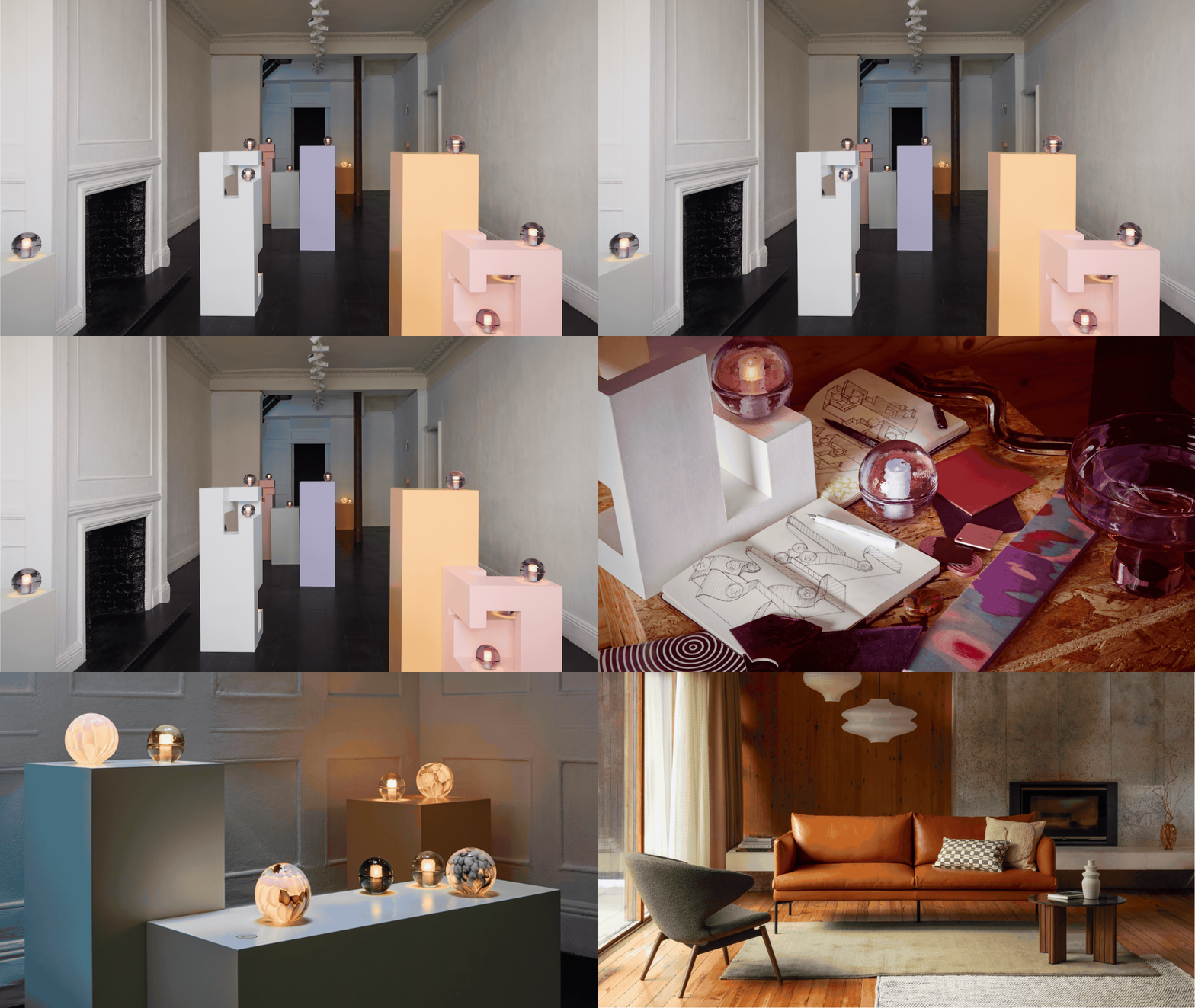
Labyrinth Dreams Bethan Laura Wood × Bocci

Bethan Laura Wood’s Labyrinth Dreams installation for Bocci.
Image credit: Photography by Ed Reeve

The pastel plinths make the Purple 14p feel almost jewel-like.
Image credit: Photography by Ed Reeve

Up close, the Alexandrite glass reveals the subtle shifts in tone that make each light feel different.
Image credit: Photography by Ed Reeve

The staggered plinths create these really playful sightlines, making the installation feel different from every angle.
Image credit: Photography by Ed Reeve
My first visit was Bocci on Bateman Street, where Bethan Laura Wood created Labyrinth Dreams around the brand’s new Purple 14p light. Bethan is known for her expressive use of color and materials, so I already felt the installation would be visually joyful.
And it really was. The colorful plinths and sculptural arrangements of glass lighting were placed in a way that felt really intentional. What I loved most was the curiosity in how the materials behaved. The surrounding colors seemed to alter how the glass looked, making the whole installation feel almost constantly changing. The Purple 14p is made from Alexandrite glass, which responds differently depending on the light around it. In warmer light, it takes on softer lilac and pink tones, while cooler light brings out deeper blues and smokier shades. In person, the effect felt much subtler and more beautiful than I expected.
When I pointed out the tiny bubbles suspended within the glass, Nora from Bocci explained that they’re part of the beauty of the process. “A lot of products are a result of some sort of accidents,” she told me. “We just play with processes and see how they react or interact with other materials.”
The Purple 14p also builds on one of Bocci’s most recognizable designs. The original 14 Series launched in 2005 as a suspended glass pendant, and the 14p reworks that same imperfect spherical form into a portable, rechargeable light.
Future Icons by Heal's


My next stop had to be Heal’s for Future Icons, an exhibition built around a simple but interesting question: what gives a piece of furniture or lighting enough staying power to become a design classic?
When I spoke with a member of the Heal’s team, he explained that many of the pieces selected are designs customers have returned to again and again over the years. They may not be the newest or most attention-grabbing pieces in the store, but they’ve lasted because they still feel relevant as interiors change around them. Seeing them together made me think about 'timeless design' a little differently. Longevity can actually be quite subtle. It might come down to how something is made, the materials, the proportions, or a silhouette with enough character to feel distinctive without belonging to one particular moment.
As an interior stylist, I’m always searching for pieces that can truly elevate a space, and the Matera sofa exemplifies what I value most in enduring Italian design. It has these elegant proportions, really thoughtful craftsmanship, and the kind of refined silhouette that gives so many iconic furniture designs their staying power.. Its plushness invites layering for a relaxed look, yet its clean lines let it anchor more contemporary or minimal interiors just as effortlessly. This is the type of sofa I recommend to clients because it adapts gracefully as tastes evolve; instead of dictating the direction of an entire room, it supports and enhances it.


Better Living by Design


A short walk from Heal’s, I ended up at The Heal’s Building for Better Living by Design, where I met Yasmin Jones-Henry, one of the exhibition’s curators and founder of The Lab W1. Yasmin is a curator and placemaker with a specialism in sustainability, design and culture, and one of the talks in the wider programme asked a question I found especially interesting: what if the future of design is handmade in the age of AI?
What made the exhibition feel particularly relevant to Soho was Yasmin’s conversations with the local community. Instead of just presenting finished objects, the exhibition opened up the worlds of the makers, materials, and processes behind them. That question about handmade design felt more tangible as I moved through the space. We’ve already seen material innovation become a much bigger part of the sustainability conversation in interiors, and here, overlooked materials had been reimagined into furniture and objects, bringing longevity back to craft. Here, longevity felt like it went one step further, looking not only at how long we live with something, but at the materials, processes and people behind how it was made.
And I think that’s where the conversation gets really interesting. In a world of ever-faster design, looking beyond the finished piece — to how it came to be, who made it, and what we truly want to live with — feels more important than ever.
There’s still plenty more to see from London Design Festival, and I’ll be sharing the moments that genuinely stand out as the week continues. Sign up to the Livingetc newsletter to follow along.
