In a Design Scene That Can Feel 'Cookie-Cutter', London Craft Week Shows That Handmade Furniture Still Makes a Difference — In and Outside the Home
As mass-produced dupes hinder the legacy of beloved design icons, the artisan community holds the secret to long-term authenticity, say its makers

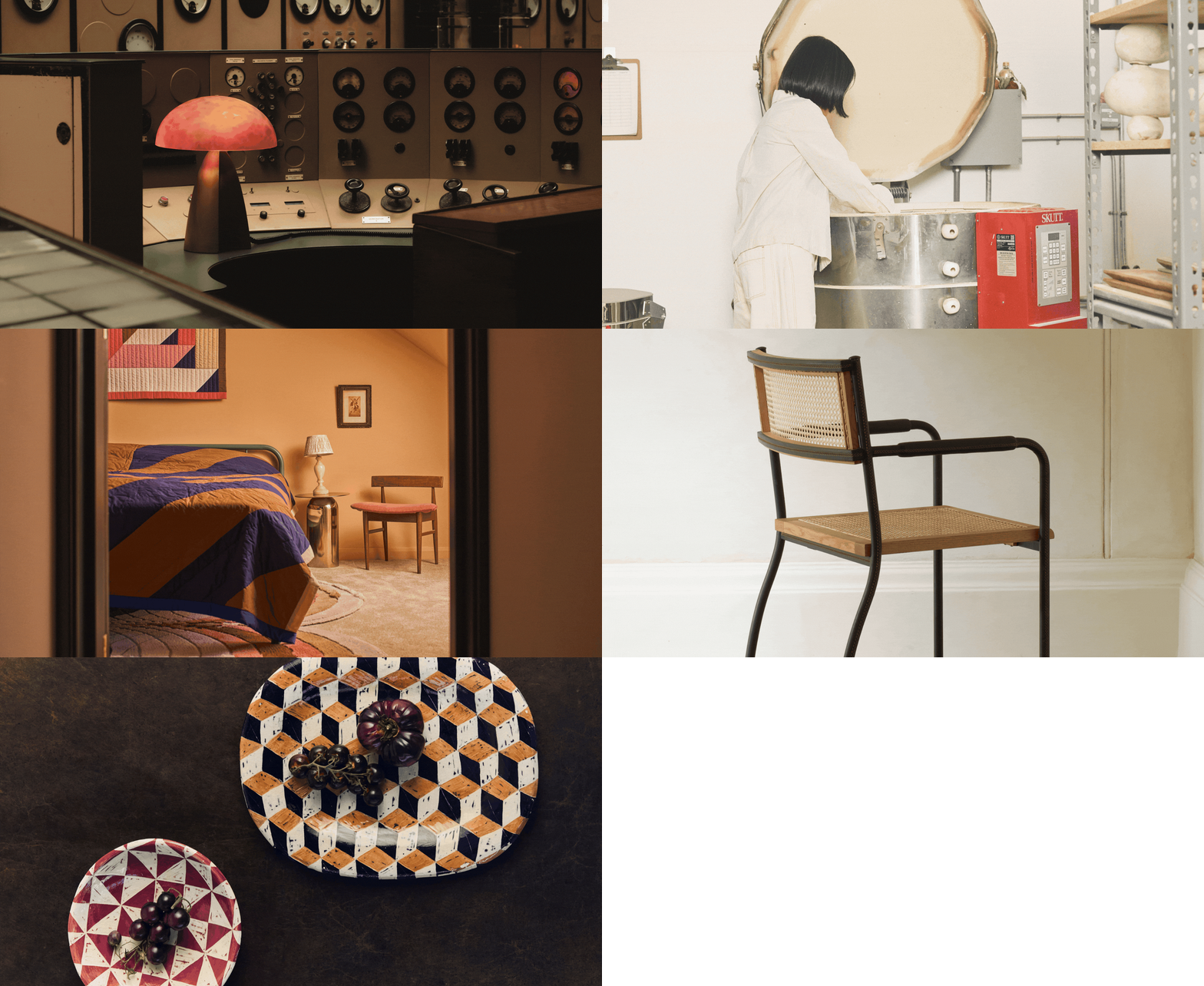
In a recent editorial meeting, our editor, Hugh Metcalf, my colleagues, and I found ourselves wondering: what's the real aim of a design week, if it doesn't directly serve the community it's held within? We were discussing the latest edition of Milan Design Week, which ran April 20-26 and was attended by — when not directly hosted in collaboration with — an ever-increasing number of luxury fashion brands, with storms of influencers spotted at most initiatives sometimes even outweighing both designers and local attendees in number.
As London Craft Week continues through Sunday, May 17, rapidly followed by Clerkenwell Design Week (May 19-21), the same dilemma returns to haunt us, this time in the British capital. The difference, though, is that this time the answer seems to come straight from the source: London Craft Week wants to preserve human craftsmanship for makers and those who get to enjoy its fruits for decades to come, proving that one-off, handmade furniture can still be the secret to a home that's inspiring and familiar; a home that, grounded in personal gestures and stories, never grows old.
Clerkenwell is "home to more creative businesses and architects per square mile than anywhere else on the planet," write the organizers of London's anticipated festival, and that alone makes Clerkenwell Design Week an unmissable appointment for budding designers and established studios alike. Because, more than anything else, design exhibitions like these are "places of exchange and dialogue between people — those within the industry, as well as the wider audience," Spanish designer Tomás Alonso tells me over email. They are an occasion to find out what's new or resurfacing in the zeitgeist before anyone else, and why you should care.
A Look at the Inner Workings of Homeware — Why London's Design Weeks Matter

For London Craft Week, TOAST hosted a panel discussion on "how craft continues to evolve, its cultural relevance today, and the enduring importance of making in a fast-paced, digital world". In the picture: jewelry maker and designer Egle Sitkauskaite caught at work.
For Clerkenwell Design Week 2026, Alonso imagined El Salón, a group presentation showcasing new work from nine leading Spanish brands as a multifaceted yet cohesive tapestry, installed within the storied architecture of St. John's Gate's Chapter Hall for Interiors from Spain in collaboration with Disegno.
A minimal set design of organic fabrics was chosen to let "the rich diversity of contemporary Spanish design shine", redirecting the attention to the material of the homewares, the lighting and ceiling fixtures, and the accessories on view, and the manufacturing processes behind them.
In the same way that the display juxtaposes the innovative approach of the spotlighted studios, which include Yonoh, Mario Ruiz, and Huguet alongside Alonso's namesake practice, with the location's Victorian-era Gothic ambiance, and prompts viewers to consider how craftsmanship has evolved over the centuries, "this exchange is key to understanding if we are moving in the right direction and to growing new opportunities," he says of the interplay between design insiders and amateurs that initiatives like London Craft Week and Clerkenwell Design Week facilitate.

Maker Linnan Ye photographed at the wheel.
Image credit: TOAST

Egle Sitkauskaite, Hannah Watts, Jacob Marks, Linnan Ye, and Yuichi Romita are the protagonists of TOAST's New Makers 2026 programme and London Craft Week showcase.
Image credit: TOAST

A glimpse at the laborous manual process behind Jacob Marks' bespoke vessels.
Image credit: TOAST
Studio Brocky's founder, Max Brockbank, embraces design fairs and other collateral events "as a reminder that there are still people blowing glass, casting metal, and spinning wool, and that those skills carry generations of knowledge that can't be replaced by a prompt," he shares.
Rather than simply becoming a celebration of the latest technological advancements in the field, or worse, fixating on how AI is taking over it, London Craft Week and Clerkenwell Design Week together show that "craft is inherently local; it's shaped by place, by tradition, and by the fact that every pair of hands produces something no other pair could," Brockbank says.
The artisanal creations at the heart of both appointments turn this very belief into objects and furniture which, unlike anything else, you'll want to cherish till they come undone.
The Antidote to the Age of Design Lookalikes? Furniture That Bears the Sign of Its Mastermind

"Craft belongs in life, not behind glass," says Studio Brocky's founder Max Brockbank. During London Craft Week, the brand's sculptural furnishings add further retro-futuristic flair to the interiors of London's listening bar New Forms.
Driven by the conviction that "interiors should hum with a subtle tension, like the first chord that sets a song's tone", Studio Brocky debuted last autumn with a cinematic, retro-futuristic collection unveiled inside London's iconic Battersea Power Station. During London Craft Week, the brand is bringing a selection of A Space Odyssey-like, hand-blown glass and cast metal furnishings — "pieces meant to endure, be touched, admired, and remembered" — to New Forms, a buzzy listening bar and creative space off King's Road.
"Everything is made in Britain," Brockbank explains. "I grew up around steelworkers in the North East: producing here is a way of investing in that ecosystem and keeping those skills in a contemporary conversation."
For its launch last year, Studio Brocky released a homeware line of lamps, seating, and coffee tables characterized by sinuous, monolithic forms assembled into functional artworks, nodding to the essential, structural rawness of Brutalism but enlivened by a 1970s sensibility.

During Clerkenwell Design Week, Huguet's Rammed Earth Tiles will appear in "El Salón", a spotlight on contemporary Spanish design bringing together some of the country's most innovative workshops of craftsmanship.
Image credit: Huguet

Studio Brocky's designs pair the fantastical silhouettes of the Space Age era with the rawness and character of Britain's industrial heritage, with all pieces proudly manufactured in Britain.
Image credit: Ben Anders. Design: Studio Brocky
The selection of designs on display this week expands that approach: "there's always been a friction in the work between industrial and glamorous, something that feels both grounded and otherworldly," says Brockbank. "Each piece is a sculpture, but it's designed to be lived with, not looked at from a distance."
Visually, Studio Brocky elevates everyday living to an art form. But don't be fooled by its good looks: these furniture items were actually designed to be used. "The conversations that happen around physical objects in a real room are irreplaceable," shares the house's mastermind.
"At New Forms, the work lives alongside the rhythm of the space, encountered over coffee by day, or in a vinyl session on a Friday night. That's deliberate: these pieces are precious and deserve care, but they shouldn't be lived with preciously. Placing them in dialogue with music and the very culture that helps inspire the work strips away the formality and lets people engage on their own terms." Because "craft," Brockbank adds, "belongs in life, not behind glass."
A Centuries-Spanning History of Making at Play — How Artisanal Furniture Brings the Past Into the Modern Age
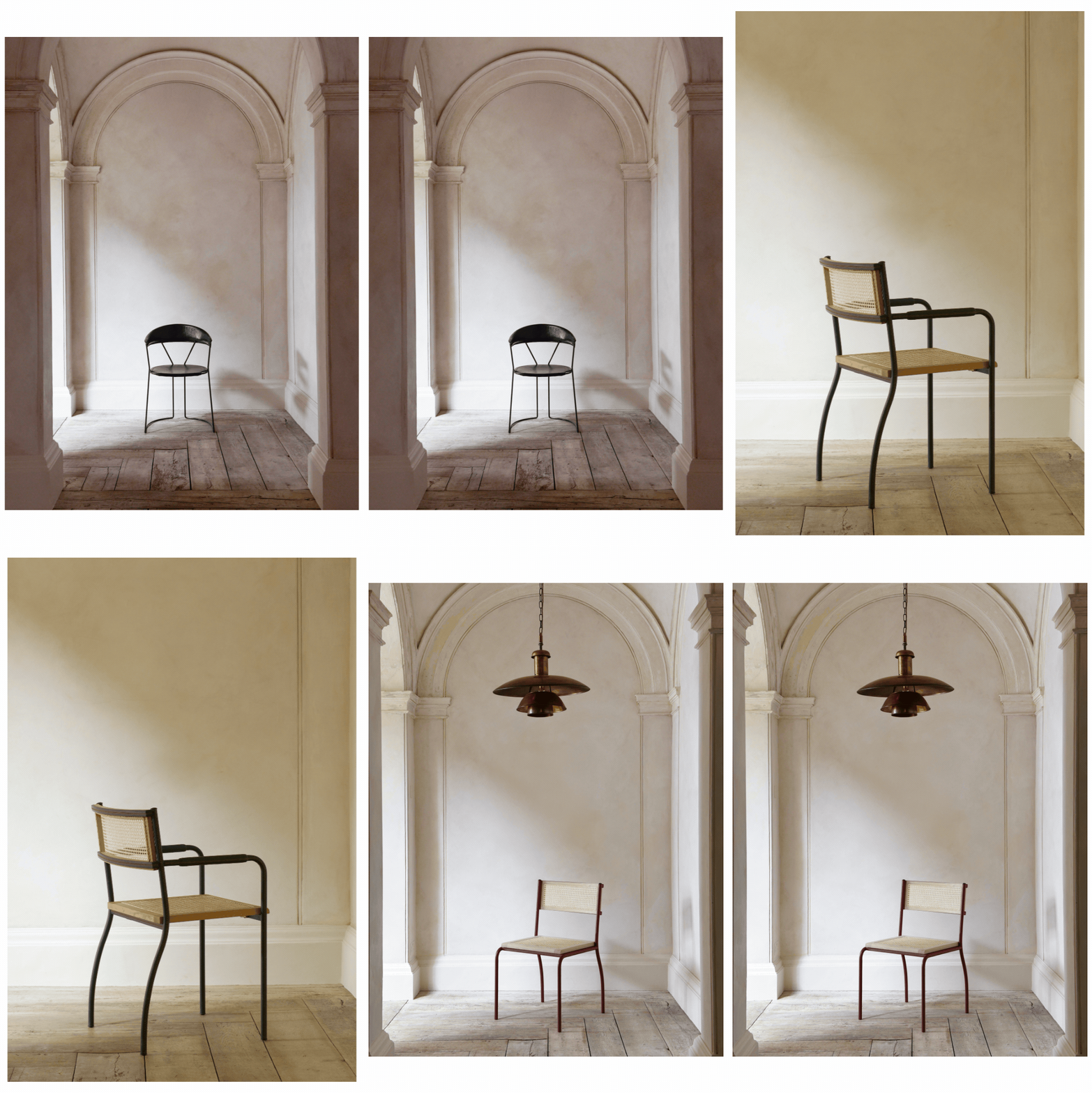
A selection of leather-stitched furniture pieces by designer and gallerist Rose Uniacke, who looks to her collaboration with expert makers as "the backbone" of her work, features among the projects of this year's London Craft Week.
In the midst of the AI frenzy, it doesn't take long to forget that human artisanry is something that has evolved and has been perfected for centuries. Something that continues to inform the way we live and who we are today. Appointments like London Craft Week and Clerkenwell Design Week force us to tune into the British capital's craftsmanship legacy, as it manifests among its busy alleys.
"London is such a cosmopolitan city, with a rich history steeped in craft," Oxfordshire-based ceramicist Emma Louise Payne tells me. "Evidence of this history can be seen in our street names — from Goldsmiths Row, Threadneedle Street (needle makers), Cannon Street (formerly Candlewick Street for candle making) to Bread Street, London was a hub of making in its origins."
As we become more digital and detached from the artisans of the objects we love, design weeks allow us to celebrate those who keep these traditions alive. They capture how small batch-produced homeware can help us reclaim a more tangible, and genuinely connected lifestyle, by showing us the faces, hands, and stories that helped shape what now sits in our apartment, and keep us away from the poor quality, polluting practices, and waste of stuff produced on a mass scale.

A bedroom part of the immersive group show Seven Crafted Stories, "an immersive celebration of contemporary craft with exhibitors including Aimee Betts, Davey Powell, Emma Louise Payne, Jochen Holz, Monica Findlay, OTZI, and Richard Goldsworthy, part of the London Craft Week programme and open at gallery Atelier Seventy-Six.
Throughout London Craft Week, Payne will be playing host to Seven Crafted Stories, an ongoing group showcases reuniting contributions from seven makers working with leather, wood, metal, glass, weaving, and ceramics across, at Atelier Seventy-Six, the West London townhouse she's transformed into a gathering and exhibition space for lovers of all things art, design, and creativity.
The presentation spans the house's different rooms and levels: Norfolk-based studio OTZI reflects on the emotional nature of homeware with a heirloom furniture line complete with a curation of objets d'art crafted from British hard wood and leather. Richard Goldsworthy embraces the textures and grain of wood and cast pewter in home accessories that abstract the beauty of nature. While queer textile artist Davey Powell inserts an uplifting, playful note into Atelier Seventy-Six's interior through his irreverent, colorful handwoven quilts.

Richard Goldsworthy's "Atlas".
Image credit: Alick Cotterill

Emma Louise Payne's "Prie-Bien Chair and Self Reflection Alcove".
Image credit: Alick Cotterill. Design: Emma Louise Payne

OTZI's "Rosette Mirror".
Image credit: Alick Cotterill. Design: OTZI
Payne's Prie-Bien collection are is one of the highlights of this immersive display. It "reinterprets religious and devotional objects for the contemporary home, transforming historical forms into spaces for everyday ritual, rest, and introspection, and exploring how spirituality, self-care, and contemplation can exist outside formal religion and within daily life," she explains.
Cast from slab-built ceramic stoneware with reclaimed materials, including antique church furnishings and kneelers, the line allows obsolete items to take on renewed meaning.
Here, "a shrine to oneself becomes a mirror for the entranceway, a place for keys, arrival, and self-reflection, while a bedside table becomes a small altar for sleep, rest, and disconnecting from the fast digital world," Payne says. "I'm interested in how these objects can quietly encourage moments of pause and care within ordinary routines."
In an hyper-mediated, ever-moving society, the ceramicist's reinterpretation of sacred furnishings gives faith — intended as a space other than that of production, instead dedicated to personal growth and research and regeneration — a different, more universal appeal.
"Where the True Value of Craft Lies" — How Design Makes Room for Community

"At New Forms, the work lives alongside the rhythm of the space, encountered over coffee by day, or in a vinyl session on a Friday night," Studio Brocky's Max Brockbank says of the music-fueled setup of his London Craft Week display.
Payne isn't the only one to view London Craft Week as a brief moment of separation from the chaos of the outer world. A moment that, through dialogue, lets us forge deeper bonds with one another. "Moments like London Craft Week and Clerkenwell Design Week feel especially meaningful in an increasingly fast-paced cultural landscape," says TOAST's Head of Home Judith Harris.
While technology continues to advance, she sees the desire for objects that feel personal, tactile, and unique as ever-present. "Careful craft and design offer something deeply human, and initiatives like London Craft Week help preserve traditional skills while also highlighting new voices, materials, and perspectives."

Jacob Marks' contribution to this year's TOAST New Makers programme comes in the form of resin-made vessels and objects.
Image credit: TOAST

"Ultimately, we are all social beings, and so the value of real-world conversations and connections is not one to be undermined," concludes Marks.
Image credit: TOAST
That's a mission that the beloved sustainable fashion and homeware brand pursues personally. London Craft Week coincides with the announcement of the house's New Makers 2026 programme: now in its eight edition, the initiative "supports emerging makers through close mentorship and a platform to develop and share their work, with all profits returned to the maker," Harris explains.
The latest cohort includes multidisciplinary artist and ceramicist Hannah Watts, Estonia-based jeweller Egle Silka, material innovator Jacob Marks, known for his sculptural exploration of renewable and biodegradable pine resin, San Francisco-based ceramicist Linnan Ye, and Yuichi Romita, a potter uniting Japanese-style ceramic heritage with contemporary Scandinavian influence. For Harris, "each maker reflects a shared interest in craftsmanship, longevity, and the expressive qualities of raw materials."
"To me, London Craft Week represents the chance to engage with the material world in a deeper and far more holistic way, not just marveling at a flat video or photograph on a screen — which may or may not be AI-generated — but appreciating the true tactility and materiality of objects," Jacob Marks, part of the 2026 TOAST New Makers cohort, tells me. "Even more valuable is the chance to speak to the makers behind them, and learn about the techniques and relationships that have allowed each piece to be brought to life, which, to me, is where the true value of craft lies."

Developed over four years experimenting with the material, the collection seeks to understand how resin "can be revived and reimagined after being widely utilized around the world throughout history".
Comprising three pine resin pieces currently on view at TOAST's Shoreditch store, The Explorations in Pine Resin is a series of functional designs (vessels, handles, and a lamp) "born out of over four years experimenting with the material, trying to understand its unique properties and qualities, and how it can be revived and reimagined after being widely utilized around the world throughout history".
The resin line these three creations stemmed from was first exhibited during last year's London Design Festival. After that, Marks was invited to develop new commissions from the same material, including works for the spectacle companies Monc's new store on Monmouth Street. "To me, this illustrates just how important physical displays are," he concludes. "Ultimately, we are all social beings, and so the value of real-world conversations and connections is not one to be undermined!"
Discover the full London Craft Week and Clerkenwell Design Week calendars, or shop TOAST's New Makers 2026 collection.


Did London Craft Week get you wondering about more craftsmanship-led appointments coming up this year? As the design week season reaches its peak, don't miss out on the most exciting events from Copenhagen's 3daysofdesign festival, and take notes on our insider-backed insights into the city's finest food and beverage.
Stay in London to find out why the city's coolest new design destinations are embracing a more domestic, grounded aesthetic over flashy retail design, or read local writer Debika Ray's love letter to the ongoing DIY renaissance.
Join our community of tastemakers and receive our newsletters weekly to hear about the latest in style, travel, and design before everyone else.
