"You Had One Mission: To Do the Unthinkable" — From British-Nigerian Upbringings to Global Placemaking, Yinka Ilori and Emmanuel Lawal Are Flipping the Design Game
To mark the recent release of Ilori's debut monograph, "Chairman", we speak with both talents about the lasting impressions of early family gatherings, the power of play, and breaking in

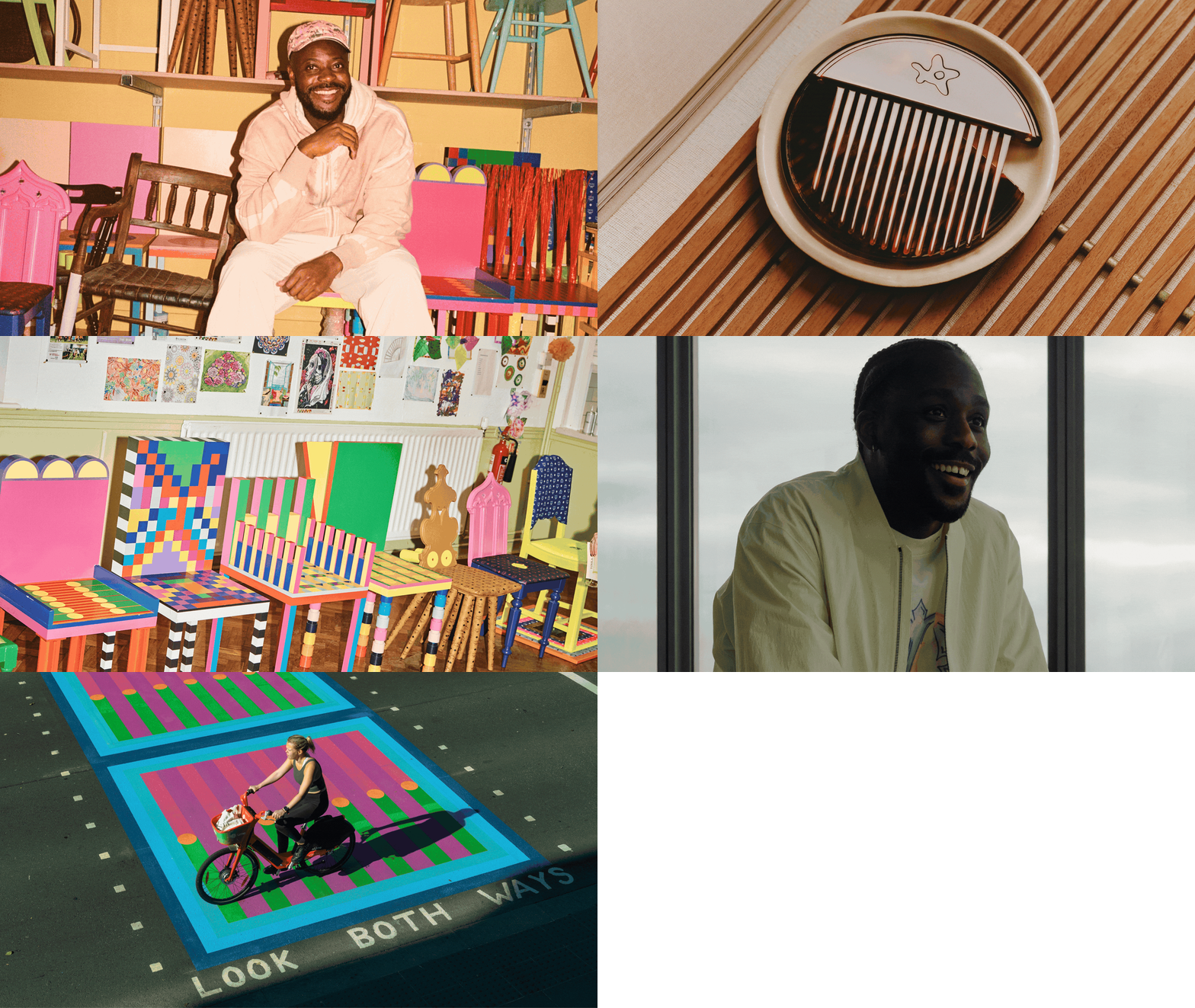
Two first-generation Nigerian-British designers living and creating in London, Yinka Ilori and visual and music artist Emmanuel Lawal, the founder of multidisciplinary design studio Forestalgia, met through their agents "back in the day", but have far more in common than just that.
Below, they tell us about how their families' veneration for the home informs their approach to furniture making, and how they understand the power and hierarchies inherent in it — the same dynamics they constantly engage with and challenge in their work today.
Moved by the conviction that "design is a global language" that speaks to anyone in the same way, a place where you can "immerse yourself in something completely new, recharge yourself, and learn whilst meeting people", Ilori and Lawal look back to the rooms and the playgrounds of their formative years to trace the continuum between their life and practice, compare inspirations, and discuss past and future projects and the truth about access.
Take us back to a Sunday table in your childhood homes. What did a typical family gathering look and sound like? Who sat where, who arrived first, and was there a chair no one dared take?

Designer Yinka Ilori, photographed alongside his shape-shifting chair collection, a project he has been developing for 20 years, starting with pieces like Two Become One, now gathered in his debut book, Chairman.
Yinka Ilori: Growing up in a Nigerian household in North London, my home had a very eclectic aesthetic. You had a mixture of bone china ware. You had lots of lace curtains from Spitalfields and Ridley Road Market, where you'd find geezers trying to sell you the latest piece they fought for in Milan or wherever else around the world they had brought it in from. My parents had put most of their money into buying Persian rugs and the lot in and around Liverpool Street. They probably weren't legit, but it allowed us to keep up with the Joneses, so to speak. We had big sound systems, vinyl players, lots of records. Music was always a part of our family home. But one of the things I remember most vividly was that we had many different chairs, and so furniture was quite a prominent part of our upbringing.
We had a velvet velour-type sofa that, back then, was luxury for us. Everyone in our circle had a similar type. Ours was brown, and it was the kind of thing families saved up all of their money to buy. Then, there was a series of monoblock chairs, white chairs you got in bulk for parties, drinks, and events you hosted at home. My dad had a special seat for himself, a corduroy armchair he'd keep in the corner. It was his favorite chair. My siblings and I were given one of the monoblock ones, which were quite uncomfortable to sit on. We were only allowed to sit on the other, better chairs when our parents were out. Without any kind of communication, when they were home, you knew what your seat was. It was automatic. That's probably when I first realized that there is an inherent level of respect, of hierarchy, that comes with certain objects within the home. I see you nodding, Emmanuel. Was it the same for you, brother?

People gathering around Forestalgia's debut furniture design, "Modular 001", a seating-cum-table piece created to connect, inspire, and entertain.
Image credit: George William Vicary

"But really, it's the plastic we kept on everything that stuck with me the most. It speaks to how much we cared about things." — Emmanuel Lawal
Image credit: George William Vicary
Emmanuel Lawal: Everyone just knew their place. That's so accurate. What you called "luxury", we called "shine", as in "shine furniture", essentially anything people would view as classy. It could be something like a range of eccentric accents in mismatched colors that technically didn't work together, but that, because of how we styled them, ended up working really well together. That 'show' furniture would still be wrapped in plastic, as we didn't remove the final layer of packaging so as not to ruin it. I never found it weird until now. For us, it was normal. Next to it, you had the standard cotton chairs with big armrests we had gotten from Dreams, the bait-and-switch furniture shop down the road. Like in your home, we all had designated seats. Only my mom or my dad could sit at either head of the dinner table. And so, as a child, you sat on the sides. When they left, my brothers and I would play dress-up, pretending to be our parents on either end of the table. But really, it's the plastic we kept on everything that stuck with me the most. It speaks to how much we cared about things.
Was there a specific moment when you realized that furniture and spaces could be 'designed'? How did those early memories set on your path?

A detail from Ilori's largest mural to date, Walk With Your Dreams. Unveiled last year, the massive artwork reframes Milton Keynes' Station Square into an oasis of color, pattern, and play.
YI: I was always aware of the power of placemaking, and convinced that design and architecture can really change how we see the world. Growing up on a North London estate, I was surrounded by people from the most different cultures and backgrounds. It was a community full of immigrants who migrated from one place to another. That was the one thing we all had in common. From the get-go, you knew you had one mission: to be successful and, in many ways, to do the unthinkable, whether that was becoming a doctor, a lawyer, a scientist or whatever it was that you wanted your destiny to be. No one around me seemed to care about the fact that that estate, those gardens and trees, were designed by creative people. I was obsessed with it.
I would go to university every day and then go back to the estate and say, "you know what, guys? There's this incredible architect in your lives, and you don't even realize it." One space I almost immediately saw the potential of was playgrounds — this idea that you can change things for the better through play, which I had a real hunger and appetite for. Pretty much from the start, I dreamed of designing my own playground for other people to enjoy, just like the one I had been playing in as a kid was designed by someone for us. The direct impact that had on my memories and experiences was what convinced me to embrace design first and foremost for communities. Being with people — my peers, friends, and family — is what made it possible for me to believe I could reimagine those types of spaces. My estate was such a huge part of that process.

During Frieze Week, Ilori brought his "Chairman" exhibition to the Islington's Walter Sickert Community Centre, the community center that watched him grow in North London.
Image credit: Kane Hulse. Design: Yinka Ilori

"It was essential that, if I want to inspire the next generation of artists and designers, charity begins at home. I needed to take Chairman to my community and bring it to their doorstep," he said of the rationale behind the initiative.
Image credit: Kane Hulse. Design: Yinka Ilori
EL: I was born in Croydon but moved to Greenwich when I was super young. I went to a primary school called Millennium Primary School when the Millennium Dome was still being built, before it became the O2, which was a stone's throw from it. It was the first primary school to have a technology board, and we had a playground called Teletubby Land. There was just so much design stuff happening there in the early 2000s as Greenwich's post-industrial docklands were being regenerated. Year 3, 4, and 5 were eye-opening for me as I was constantly exposed to so many stimuli. Some of the earliest memories I have are of technology developers coming in, making cool stuff, and allowing us to get back out to play.

Lawal was one of the talents spotlighted in Livingetc's The Future of Taste, our first-ever collaboration with Frieze's membership programme, Frieze Connect.
Every summer, while your parents worked, you were put on those 'play schemes' with educators taking you all around London. You got to know new kids and experienced different things. That's what design felt like to me — it was a place where you could immerse yourself in something completely new, recharge yourself, and learn whilst meeting people. Then, as life happens, you get pulled in different directions. Not many of my friends were interested in design. Instead, they were into music, and I felt pressured to do the same. So, although design had always been there for me, I circled back to it later in life.
Yinka, in "Chairman", each chair feels like an abstract portrait of a person. Which of your chair designs best captures the togetherness that distinguished your childhood? What are the more delicate chairs meant to convey in turn?

Ilori, surrounded by just a few of the dozens chairs brought together by his recent exhibition and monograph, Chairman.
YI: Chair making and storytelling were two of my first loves, which is why bringing Chairman to the community center that hosted my childhood activities and housed my community during Frieze Week was pretty special. I've never really heard anyone describe chairs as portraits of people, but that's a beautiful way of putting it. It's true: these chairs are portraits of people, their life, their memories, their existence, and the impact they've had on me and my journey.
The chair I am most attached to is called Ọ̀kín, which means "peacock" in Yoruba. Peacocks are such spectacular birds, especially when they open up their train, and you get to experience their beauty and performance. They make me think of my mom, just how beautiful she was and still is today, and how vibrant our culture is. Peacocks are unapologetic — they're all about showing, being heard, and being seen. That counts for my chairs, too: they don't hide their stories, but put them on a stage for everyone to engage with.

Launched earlier this autumn, "Chairman" makes two decades of Ilori's chair making instantly tangible.
Image credit: Scott Caldwell

Inside, designer interviews, product spotlights, and the designer's storytelling-led approach to making are brought together in his signature technicolored aesthetic.
Image credit: Scott Caldwell
The goal, for me, is to design objects that speak for themselves, be it through evoking a sense of humour or sparking conversations around identity, sexuality, faith, and religion, themes I have explored from a very young age. The idea that I can take an existing object that has potentially been unloved, like a chair that's been dumped into a skip or at a charity store, and, with no permission, bring it to my studio and layer new stories onto it gives me joy.
Chairs don't need visas or passports. Objects don't need permission to hold or tell stories because, once they're in your hands, you have the power to embed whatever you may feel like embedding into them. There is an inherent hope, a faith, even, in them, a sense of going into the unknown. And chairs themselves — particularly those that were given a second life — are a testament to affirmation. You can't see the future in them just yet, but you can lean into the possibility of something great happening, if you so believe. To me, they remain one of the most powerful mediums to share stories with people around the world.
Emmanuel, what aspect of Yinka's work resonates most with you? Is there any specific piece you are particularly fond of — and why?

Before pivoting into design, Lawal created The ACS Show (ACS being an abbreviation for AUDIOCOMINGSOON), a monthly contemporary online radio show and podcast he co-hosted alongside Ashton Gohil.
Image credit: The ACS Show

Before they became friends, Ilori was one of the voices invited to engage in conversation for the format, which paired an eclectic mix of music beats with high-profile interviews.
Image credit: The ACS Show

Created within the walls of Soho House, the concept and the duo behind it took off, with bespoke activations and DJ sets hosted anywhere from Coachella to Paris.
Image credit: The ACS Show
EL: When I hosted The ACS Show podcast with Ashton Gohil a few years back, we interviewed Yinka because we were huge fans of his work. There are not many people doing what he is doing. One thing I still remember finding absolutely ingenious from the projects Yinka had done up until that point was the pedestrian crossings. Wherever you go in the world, they always look the same. In London, Yinka found his way of reinterpreting something that's very standard and ordinary and breathing fresh life into them. Where exactly were they again?
YI: We did quite a few, in White City, Tottenham Court Road, and Embankment.

"In London, Yinka found his way of reinterpreting something that's very standard and ordinary and breathing fresh life into them." — Emmanuel Lawal
EL: Right. I would say those are probably my favorite, standout pieces from Yinka's production so far. When you walk down the street, lost in thought, and see something like that, it sparks such energy in your step. You can't always touch people with an exhibition catalogue, a book, or a studio visit. But you can touch everyone when you surprise them right where they are, out in the public.
Emmanuel, like Yinka's pedestrian crossings, your piece Modular 001 is all about letting people in and engaging the senses. What inspired it?

"What I love most about it is precisely that it wasn't designed for just one person. That's what the design is for me: trying to make everyone feel included." — Yinka Ilori
YI: Man, I need that piece.
EL: Well, let's talk [laughs]. You know, I am a massive fan of different studios and designers who are making pieces like Pierre Paulin's Dune modular sofa. With Modular 001, we wanted to create something that fits into that world, elevated past mere comfort. We asked ourselves: how can we bring people to a space and allow them to sit there, indulge, work, and play, back to back, without the need to stand up? The answer was that you need more than just comfy seats. You need entertainment; you need lighting. So we essentially brought in a sound system for music and an element of illumination into a one-piece design that functions as both a table and a seat. This allows you to do a 9-to-5 there without feeling like you need to move. It can be cozy, all to yourself, or you can lounge and hang out around it with friends. You can lie down on one of the larger benches, and up to four people can sit on it at the same time. We wanted it to feel as collective an experience as a campfire, if you know what I mean.
Yinka, as a prospective collector, what is it about this design that speaks to you and your own work most? And who would you want to sit on it with?

More than a sofa, a chair, or a table, "Modular 001" caters to all the needs of time well spent.
Image credit: George William Vicary

From music and light to unrushed comfort, the design fosters togetherness through shared sensory engagement.
Image credit: George William Vicary
YI: First and foremost, I wanted to make it clear: I'm a huge fan of E and what he has been up to as well. We share similar upbringings, and to be in the same space as him and other first-generation British Nigerians like us feels truly inspiring. There's lots of us doing amazing things all around the world, and we don't even know it, but we're going to impact those who come after us greatly. Modular 001 is such a beautiful, clever idea centering the power of people and communities coming together. What I love most about it is precisely that it wasn't designed for just one person. That's what the design is for me: trying to make everyone feel included. Not only is it a piece that you can move around and be a part of through chatter, touch, and sound, but it's also a sculpture in its own right, a piece of art you just want to look at and admire. There are very few objects that have such a multi-purpose usage.
If I could invite anyone to sit on Modular 001 with me, E would obviously be there first. I would also ask my brother Foday Dumbuya, an amazing Sierra Leonean-British menswear designer who is killing it right now. He would be the perfect person to have for a Sierra Leonean-Nigerian fusion of food, music, and culture. I would then call your cousin, Dumi Oburota, the founder of 360 entertainment company Disturbing London, as well as a music manager and businessman, because what he has done over the last 20 years is sensational. Dumi really set the blueprint for a number of things, collaborations, and music deals, and I have learned so much from him. Someone else I would want to invite is my good friend, conceptual artist, composer, and all-round music genius, Peter Adjaye. He can tell you anything about music, from morning to night. I would love to share a seat with Julian Knox (aka Julianknxx), an incredible poet and artist I hope you both know.
This month, the Design Museum is celebrating Black creativity across disciplines with "The New Black Aesthetics". What was it like to enter such an exclusive, traditionally white industry? What did you have to build for yourself to make room for those who came after you?

"As much as I believe it's good to have shows that highlight Black talent, I still think it's important that we can move around in different spaces alongside the biggest artists or designers. Design is a global language, and it speaks to anyone, no matter where you're from. It shouldn't be pigeonholed." — Yinka Ilori
YI: One of the things I learned during my career is that we are all institutions. E, you are. I am. We embody it. What I mean by that is that we all carry our own stories, artifacts, and experiences. When I look at the things I've done with Chairman, and the things you've done, E, with Modular 001, we've done it on our own terms. We've created our own communities. And I think it's optional for people around us to want to come on that journey and move with us in that community. We are definitely in a very interesting time now, and there's some real fire out there — people like Ini Archibong, a good friend of mine, Samuel Ross, Ifeanyi Anidi, American designer Dozie Kanu, Simone Brewster, I could go on.
The platform is now open, and we are able to tell our own stories, travel to Nigeria and Ghana, and bring them back here so they become global. What I think is worth noting, though, is that as much as I believe it's good to have shows that highlight Black talent — which is amazing — I still think it's important that we can move around in different spaces alongside the biggest artists or designers, no matter who they are. Design is a global language, and it speaks to anyone, no matter where you're from. It shouldn't be pigeonholed.

A closer look...
Image credit: Mannners

at Emmanuel Lawal's...
Image credit: Mannners

Orbit combs, another design success by Forestalgia.
Image credit: Mannners
EL: That's right, 100%. We saw artists and designers like Yinka do this at scale to be able to believe that, wow, we could actually do this. It really does take one or two people to do it first before you can open the door, look through the crack, and be like, "alright, let me put my leg in the door so it doesn't close and squeeze my body through." But when you do get through the door, what no one tells you is that it's expensive. No one speaks of the price points to make stuff; it is not cheap, especially if you're doing it by hand and you're not a global entity. For young designers and young studios starting off, you're not building at scale or making a thousand pieces of furniture. You're doing it with local craftsmen, relying on favors. The lead times are longer, and it costs more money. The entry costs are just so much more expensive, so you do feel discouraged immediately once you come through the door. Hopefully, the more young people come through in general, the easier it will become because that gap needs to be filled with just a bit more elasticity. Because it's hard.
Yinka, you brought "Chairman" back to the community center next to the estate you grew up on. What does giving back to the place that raised you mean to you right now, and how will you carry that forward through your foundation?

A look inside Chairman, and the myriad of chair forms Ilori envisioned over the years.
YI: We launched the Chairman exhibition during Frieze, and that was intentional because I don't think any of the people on my estate go to Frieze. The kid who's going to the corner shop can't afford Frieze while their parents are working four or five jobs to put food on the table. It was essential to know that, if I want to inspire the next generation of artists and designers, charity begins at home. I needed to take Chairman to my community and bring it to their doorstep.
That was the biggest accomplishment of my career so far because it allowed young kids who are probably not going to go to Frieze or any other museum institution to come to their local community center and get close to objects that are in museum collections, including The Met, the V&A, and the Design Museum. I was so proud of the community that came out, and there was such great power in having control over your work and doing it in a place that makes sense.

In Ilori's work, no feature in the object...
Image credit: Kane Hulse. Design: Yinka Ilori

is ever purely coincidental.
Image credit: Kane Hulse. Design: Yinka Ilori

Each reflects the stories and power dynamics...
Image credit: Kane Hulse. Design: Yinka Ilori

quietly trapped in the object itself.
Image credit: Kane Hulse. Design: Yinka Ilori
It goes back to the foundation and giving back to people who need it most, having those open dialogues around what art and design are, and who gets to engage with it. We hosted some workshops there, and we hope to take those workshops to Nigeria and bring Chairman to a city over there to encourage young kids to see the importance of storytelling and design. I'm trying to get Martino Gamper and maybe even Max Lamb to Nigeria. Gamper is down — he wants to go with me. I would love to take a bunch of us, including E, to Nigeria and do a workshop during Design Week or ART X Lagos. That would be phenomenal.
Emmanuel, what's your equivalent? How do you hope to support the next generation?

"We have to create spaces for those people to come through and work within the arts — whether as collectors, buyers, or all of the other stuff. We want to create opportunities specifically for young people and disadvantaged individuals, and then just hope that they do the same when it's their turn." — Emmanuel Lawal
EL: Same, same, but different. Obviously, the level that Yinka is at now is the beacon of what I should be doing as I navigate my journey within design. We have an old saying — it's a global saying now — "each one teach one." When you get in the game and navigate the scene to a level where you feel successful, it's very important to carry the baton and create space for individuals to come through. That doesn't mean you're giving out invitations willy-nilly, but just seeing talent, fostering it, and allowing it to blossom because you know how hard it was to do it.
Simultaneously, when we set up the Forestalgia studio, we set up The Forestalgia Foundation, too. We haven't activated it at that level yet, but the idea is for us to tap into sports through product for ages 8 to 17. That's a work in progress that we're going to be working on a lot next year with local boroughs like Hackney and Greenwich Council, God willing. The idea is to create space for people to come through the door, and it doesn't solely have to be on the design side; it could be on content, administration, or many different facets. There is a massive gap between physical design and everything else that circulates around it.
My little sister, Debbie, is always saying to me, "oh, if you need help with strategy or whatever..." and for a long time I was always like, "no, no, no, we're good." Only recently have I been like, "actually, no, I need your help," because she's young and she understands how people think. We have to create spaces for those people to come through and work within the arts — whether as collectors, buyers, or all of the other stuff. We want to create opportunities specifically for young people and disadvantaged individuals, and then just hope that they do the same when it's their turn.
If the two of you were to design something together, what would it look like, and what would it say about your story so far and where you're both heading?

"I love that Yinka values his people before anything else. So a collaboration would be something to do with that — seeing what we could do for the community that would have a long-lasting ripple effect. Design-focused would be the dream," Lawal says of a prospective, co-authored project with Ilori.
Image credit: Kane Hulse. Design: Yinka Ilori

"I'm imagining 'Modular 001' speakers, the seating, the walls, the storytelling, the colors, and the patterns. Wow. I'm imagining a Yinka Ilori x Emmanuel Lawal Modular 001 music pavilion — using your design language to build a pavilion at Glastonbury or Coachella." — Yinka Ilori
Image credit: Kane Hulse. Design: Yinka Ilori
EL: When we launched the Orbit comb, one of the first questions, team-wise, was whether we should do something super elevated past this point that feels more premium and special. I had a doodle of random names and brands, and Yinka was probably the first or second that came to mind for that. First and foremost, I'd love to do an Orbit series of different pieces. Second of all, what Yinka is really good at is flipping things on their head, like he did in taking his Chairman exhibition to his community during Frieze. I love that he values his people before anything else. So a collaboration would be something to do with that — seeing what we could do for the community that would have a long-lasting ripple effect. Design-focused would be the dream.
YI: We met through our agents back in the day, and I knew you first and foremost through music. But obviously, now you're combining music, art, and design. I would love to design a listening room with you, bro. That would be wild. I'm imagining Modular 001 speakers, the seating, the walls, the storytelling, the colors, and the patterns. Wow. I'm imagining a Yinka Ilori x Emmanuel Lawal Modular 001 music pavilion — using your design language to build a pavilion at Glastonbury or Coachella.
EL: Make it Coachella just for the weather! But that's the beauty of design, because as you're saying this, I'm visualizing prints on the walls, specific color tones, and storytellers narrating as you step into the room so you're completely transported. That listening room definitely makes total sense, man. In God's time, when the time is right.
YI: Whoever is reading the interview — if you've got the money, let's go [laughs]. You know what I'm most proud about? Just seeing Yinka Ilori and Emmanuel Lawal together in the same conversation. That is beautiful and is going to inspire so many. I think you know what you're doing, and you did it, man. So thank you.
EL: Always, brother.

Continue browsing our lifestyle pages for more of these stories, or subscribe to our newsletter to get them sent to you weekly.
