I've Spent Months Sourcing the Most Design-y Dinnerware That Will Make Your Meals Look and Taste Better — Like, Actually
You can find quality dinnerware on the high street, but these brands feel a little cooler, lesser-known, and way more design-y

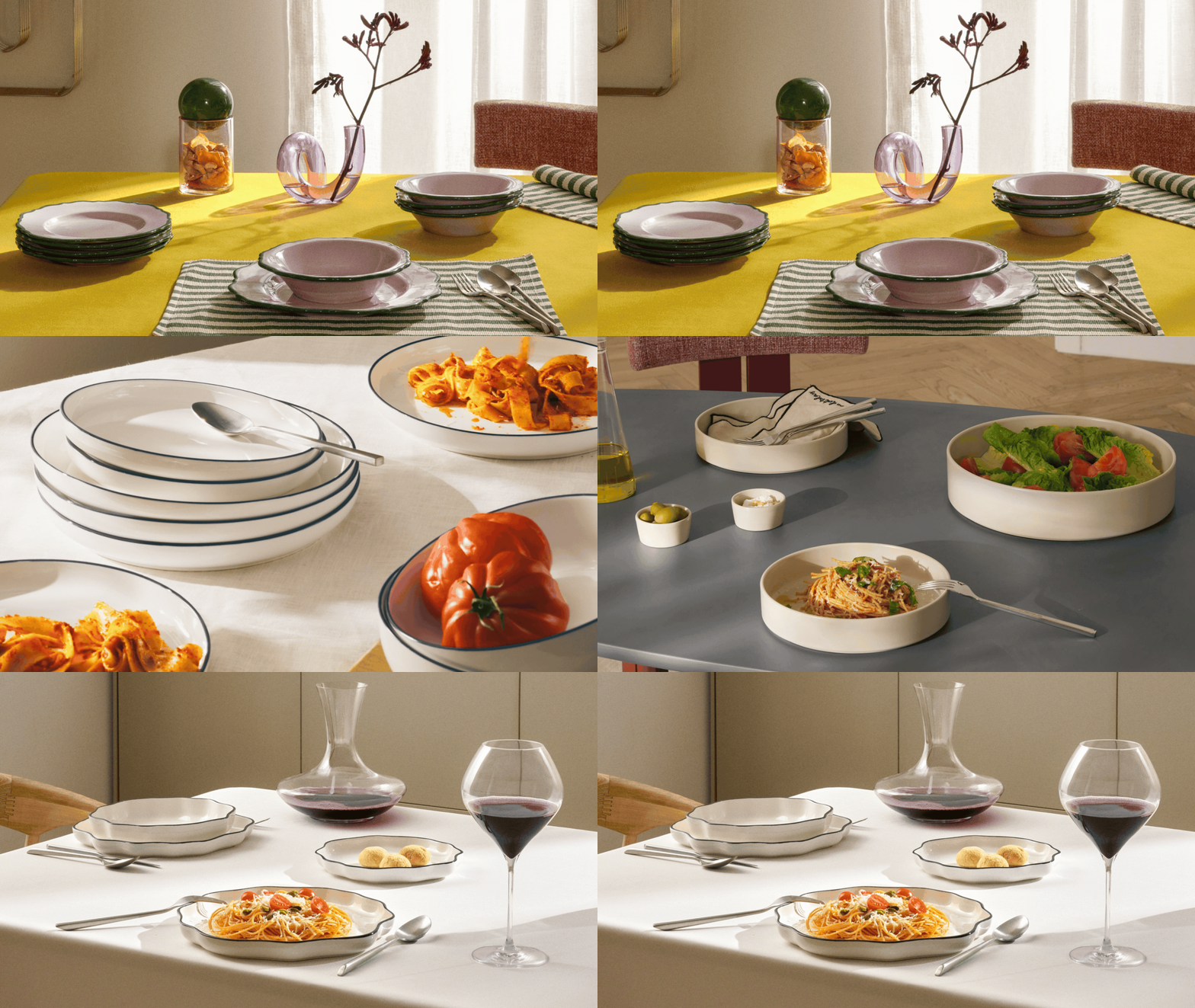
Once upon a time, people displayed their 'good China' behind glass, reserved only for the fanciest of occasions. In 2026, thankfully, that's no longer the case. That's not to say we no longer take pride in our pick of the best dinnerware, though; just that we like to use it every day. And surely that's a good thing?
But with all this added wear and tear, choosing the best tableware has become about far more than just good looks. Material, color, style, size, shape — all these factors matter even more now. Then, of course, there's whether it's machine washable, how it stacks in your drawers, what difference the glaze makes, and whether your style choice could actually affect how food tastes. (You might be surprised by that last one.)
Haven't thought about any of that when it comes to setting your table? Don't worry, I've got you. I've done my research by speaking with a stylist who works with a range of dinnerware brands (and has strong thoughts), an expert from the Ceramics Research and Testing Team at Lucideon, and a designer who's developed two plates based on gastrophysics that explore how color, shape, and finish can change your perception of taste. Yeah.

I've been on a hunt to find the best dinnerware to shop.

Emma is an interiors editor with over half a decade in the homes industry. As part of that, she's very fortunate to be regularly invited to countless dinners and events hosted by brands and designers, where she's seated at some of the best-dressed tables (and isn't afraid to check the underside of plates and glassware to find out where it's from). She's also worked in hospitality in the past, which gave her a crash course in how important durability is when picking dinnerware.
On top of that, I've been visiting stores and showrooms to see pieces in person. Sometimes there's nothing quite like picking something up to get a true feel for it, but that takes time.
My findings? You can get some really solid dinnerware from the high street — convenient sets that will get you everything you need in one go (plates, bowls, sometimes even mugs), made from durable materials that are dishwasher-safe and absolutely do the job.
High Street Dinnerware Collections
- John Lewis dinnerware: with prices starting from just £22
- Habitat dinnerware: don't miss this pretty 'Bobbin' stoneware set
- Next dinnerware: with almost 500 styles to choose from
- M&S dinnerware: including this gorgeous glossy khaki dinnerware set
- Dunelm dinnerware: 6-piece dinnerware sets start from just £10
- DUSK dinnerware: this speckled 'Nori' dinnerware set looks so expensive
- La Redoute dinnerware: these bubble-y Toria plates are so good

I always make a beeline for the table in any homeware store.
But below, I've curated a list of some of the coolest, perhaps slightly lesser-known, more left-of-field dinnerware brands that will have your guests sneaking a look under their plates for any hints about where to buy it (don't lie — we all do it).
It's a combination of my own experience and advice from those who know. For example, "Ginori always creates the most beautiful patterns and color palettes that are so of the moment, but you know they will never date," interior stylist Steve Cordony (who regularly hosts table-setting masterclasses) tells me. "Similarly, Wedgwood and Society Limonta create dinnerware that is true to their style and design ethos."
So, here are the dinnerware brands to know, according to my research.
Anthropologie

You can also pick up pretty glassware and table decor while you're at it.
If the words playful, fun, and on trend sound like your style, you're going to want to head straight to Anthropologie to buy your dinnerware. But while they're probably best known for color and pattern, you can also pick up more classic designs, too. For example, Livingetc's editor Hugh Metcalf has the Jasper dinnerware set; "They're very Japandi," he says. But it's also where you'll get those accent side plates and characterful one-offs that will pack your table setting with plenty of personality. Anthropologie also stocks a few other cool brands, including Damson Madder's homewares collection. Prices are slightly higher than what you'll find at other high street brands, so I wouldn't be looking to buy a complete dinnerware set here, but rather the accent pieces for your table. It's also great for gifting, if you're headed to a housewarming or looking for a gift for hosts.
Shop Anthropologie Dinnerware 
My personal favorite is this collaboration with cookbook author Molly Yeh that draws on her Chinese and Jewish heritage and life on a Midwestern farm. It's so pretty, you'd be forgiven for 'storing' it on your wall as a work of art.
BITOSSI Home

BITOSSI Home has a distinctly fun Italian vibe with its dinnerware.
Another playful dinnerware brand to have on your radar is BITOSSI Home, an Italian lifestyle brand with an unmistakably fun vibe. Think bold colors, quirky motifs, and interesting shapes. The collection includes tableware, plates, flatware, placemats, glassware, textiles, and decor. In terms of quality, the brand draws on the heritage of Bitossi Ceramiche, a historic Tuscan manufacturer with over 150 years of expertise in Italian ceramics. While most of the dinnerware is porcelain, you can also find ironstone (a heavier ceramic), glazed ceramic, and bone china in some ranges. Touching on its artisanal appreciation, BITOSSI Home also regularly collaborates with designers and artists including La Tigre, Gentucca Bini, and Sam Baron, as well as brands like Gucci, Barilla, and La Cucina Italiana. Surprisingly, even though it's mostly hand-painted, I was pleased to discover most designs are even dishwasher-safe.
Shop BITOSSI Home Dinnerware 
I'm drawn to the celestial-lean of this plate from BITOSSI Home. It's porcelain, dishwasher safe, and crafted by hand, meaning each design is actually completely unique.
Bordallo Pinheiro

If you're not afraid of being a bit different, go straight to Bordallo Pinheiro.
Full disclosure: I'm a big fan of Bordallo Pinheiro. Started in 1884 by Portuguese ceramicist Raphael Bordallo Pinheiro; even if you haven't heard his name, I can bet you've seen his iconic 'cabbageware'; it's gone on to inspire many, many dupes. Is this where I'd shop for classic white dinnerware? Absolutely not. Instead, the brand's vegetable-, sea creature-, and flower-shaped dinnerware are collectables — conversation starters. I personally own two salad platters, two dipping bowls, and a large cabbage-shaped fruit bowl, and I get just as much pleasure out of styling them on my shelves as I do on the table. In terms of materials, most are made from high-quality earthenware (local Portuguese white clay), which allows the artisans to mold the intricate shapes. They're then glazed and are dishwasher-safe (though I tend to handwash mine to be safe). You can also conveniently shop these pieces from John Lewis, Farfetch, and Arket.
Shop Bordallo Pinheiro Dinnerware 
A classic; its gone on to inspire many other designs, but if you're someone who cares about honoring the original design, this is it.
Ferm Living

Ferm Living's dinnerware has a really cool, effortless, artisan aesthetic.
Ferm Living may be a well-known homewares brand, but perhaps not so much for its dinnerware range. And I'll be honest, it's limited, but every single piece is so, so beautiful. I actually own the Tumbled Stainless Steel Plates, and they're my most reached-for. Noted, they're small (more a side plate than a dinner plate), but work perfectly for a 'girl dinner', for serving sides as part of a larger meal, or for lunches. Plus, the tumbled stainless finish means I never have to worry about scuffs or scratches; it's all part of the patina. Aside from that, Ferm Living has glazed stoneware plates, 'layered' stoneware, and reactive glazes, all of which feel effortlessly handmade. Yes, it's a limited range and slightly more expensive, but these make for great gifts for the design-inclined, too.
Shop Ferm Living Dinnerware 
These tumbled stainless plates are so on trend now, but also feels effortlessly timeless. Plus, you only really need two of these — not a whole set.
Ginori 1735

Ginori 1735 is top tier when it comes to dinnerware brands.
When it comes to 'designer' dinnerware, Ginori 1735 is the brand that comes to mind. And as such, it comes with a designer price tag (for instance, a small bread plate starts at £75). For that price, however, you get a piece of history — Marquis Carlo Andrea Ginori started a porcelain factory in the 18th century with a focus on beauty. In 1954, it was translated for the table, and before long, it was collaborating with some of Italy's greatest designers: Franco Albini, Angelo Mangiarotti, and Aldo Rossi, to name a few. Then, in 2013, it was acquired by Gucci, and today continues to release beautiful dinnerware that's made in Italy, hand-painted, and, in some cases, even finished in pure gold.
Shop Ginori 1735 Dinnerware 
Available in a range of unsuspecting color combinations, I particularly like this deep green with the well-known carnation floral motif.
H&M Home

H&M Home has some really well-priced and on trend dinnerware.
If you're looking for quality, stylish, but not so expensive dinnerware sets and standalone pieces, don't skip H&M Home. From simple, timeless styles to more trend-led designs, you'll be hard-pressed to spend more than £200 to set a full table (I'm including platters, glassware, etc. in that, too). It won't be fine bone china, but most are either porcelain or stoneware, which means it's durable and conveniently microwave- and dishwasher-safe. Just like its fashion, H&M is quick on trends, but has really come a long way in the last few years, and I own plenty from H&M Home that absolutely stacks up against more expensive brands.
Shop H&M Home Dinnerware 
I absolutely adore the color of these baby blue dinnerplates from H&M Home. Plus, I love the 'blate' silhouette that makes them way more versatile to use.
Wedgwood

If classic is your vibe, Wedgwood is a brand worth knowing.
As far as the classics go, Wedgwood is likely a name that will come very quickly to most people's lips. In fact, it's interior stylist Steve Cordony's everyday go-to dinnerware (the Intaglio by Wedgwood collection, in particular, he tells me). "It has a simple round edge, but a debossed detail on the rim, and my favorite rim style is a simple gold trim," he adds, before flagging that anyone considering investing should be mindful that this dinnerware is hand-wash only. The brand dates back to 1763, when its founder, Josiah Wedgwood, was appointed as Queen Charlotte's 'Potter to Her Majesty'. Dinner sets are typically made from fine bone china, and prices for sets start at £100 for a four-piece set (which includes a mug, plate, soup bowl, and bowl), so it's certainly not the cheapest — but a great wedding gift for the design-minded.
Shop Wedgwood Dinnerware 
Design Vera Wang has been collaborating with Wedgwood for over two decades now, and her Luxe Graphite collection is a particular favorite and ever-so timeless.
Westwing

Westwing stocks its own collection as well as other popular dinnerware brands.
Westwing is a relative newcomer to the UK design scene (that said, it's been big in Europe for ages now). And while it's a great place to shop a range of really cool brands (think Broste Copenhagen, POLSPOTTEN, and &klevering), it's also absolutely worth checking out Westwing's own collection, especially the dinnerware. You can get generous dinnerware sets for 12 or 18 people for just over £100 (a bargain), in both timeless and more fun, playful styles. Honestly, if I were looking for a big set, this is probably the first place I'd go. In terms of materiality, you're likely looking at glazed stoneware or porcelain.
Shop Westwing Dinnerware 
How charming are these hand-painted green striped plates? They're also available in peach, and are currently on sale.
FAQs
What Is the Best Material for Dinnerware?
In short, China is generally considered the most durable dinnerware; however, "China, porcelain, and stoneware are all durable materials as they are vitrified at very high temperatures," explains Louise Rosie, head of design at British heritage tableware brand Wedgwood.
Speaking with Ian Campbell, a senior scientist at Lucideon (an independent materials science consultancy and international testing laboratory based in Stoke-on-Trent, UK), I dove a little bit deeper into the subject.
"While some would regard earthenwares as a lower price point, there is plenty of very good, well-manufactured earthenware capable of long service," he tells me. And often the design of your dinnerware can impact even the strongest material. "Manufacturing and shape can trump intrinsic properties," he explains. For example, "For edge chipping, you would expect strong wares to be better, but if the edge shape is fine (slender), the resistance will be poor."
Ian Campbell is a senior scientist at Lucideon, an independent materials science consultancy and international testing laboratory based in Stoke-on-Trent, UK (formerly known as the British Ceramic Research Association). He's worked in the industry for over 40 years, specializing in ceramics, earthenware, bone china, and glassware. He's regularly involved in assessing and developing ceramic materials and glazes, so when it comes to knowing the best material for dinnerware, he's incredibly informed.
And then there is the glaze. A pet peeve of mine is when you get gray scratch marks on your dinnerware from knives. I asked Ian whether this was a sign of poor-quality dinnerware, and he explained that while it can be the result of a "rough" glaze, it more often has to do with the quality of your cutlery. "Good quality cutlery actually uses different grades of steel for different things," he shares, adding that "cheap and soft" cutlery is more resistant to detergents, leading to the buildup of scratches and "chatter flaws" as a result of stress fractures in the glaze.
"Basically, within reason, you get what you pay for," Ian concedes (though he flags that the law of diminishing returns applies at the higher end). "If ware is very cheap, don’t be disappointed when it doesn’t last very long."
From a dinnerware trend perspective, Steve Cordony says he's noticed a shift lately towards more traditional-style plates with heavy patterns and a strong use of color. "These tend to be porcelain with more high-gloss finishes," he adds, "rather than the organic earthenware we have seen over the past few years."
What is the Best Color for Dinnerware?
It feels like such a personal question, but there is actually science behind this. Livingetc's editor, Hugh Metcalf, says he'd "generally keep it simpler with the design, looking towards softer, more neutral colors, and avoiding patterns (or choosing plates with patterned rims, only). You eat with your eyes first, and a plate of food that looks chaotic set against something too garishly bright or patterned isn't going to get your appetite going."
So, does that mean a white dinnerware set is always best? Not necessarily. HAK Studio, a Polish design firm, recently developed a tableware range designed to "enhance taste" based on gastrophysics. Professor Charles Spence conducted a study at the University of Oxford that found that "Our brain is constantly combining information from different senses and using previous experiences to predict what is about to happen," the studio's co-founder and industrial designer Żanetta Korsak tells me.
So, when we see a color we associate with sweetness, the brain starts building an expectation of a sweet experience. "Once we actually taste the food, this expectation becomes part of the multisensory information the brain uses to construct our perception of flavor," Żanetta adds.

The 'sweet' plate is designed to make food taste sweeter.
Image credit: Natalia Gromiec. Design: HAK STUDIO

They found that the 'salty' bowl really does change the flavor of food.
Image credit: Michał Kałużny-Włodarek. Design: HAK STUDIO
As such, the team developed a 'sweet' plate and a 'salty' bowl. "The plate combines cream and pink porcelain, reminiscent of strawberry sweets or mixed toffee," the designer shares, while "Its glossy glaze looks almost sticky, like a sugar glaze, and catches the light like a swirling liquid."
"Our off-white Salty Plate does almost the opposite," she continues. "Its exterior is matte, rough, and slightly crumbly-looking. Inside, we combined textured porcelain with a transparent glaze to create something that visually resembles crystallization, almost like salt crystals."
"What interests us is that the plate doesn't change the chemical composition of the food; it changes the context in which the brain interprets it," Żanetta shares. So, safe to say, it's worth considering your personal associations with certain colors, textures, and shapes before choosing your dinnerware.
What Is the Best Shape for Dinnerware?
Professor Charles Spence's research also looked into how the shape of your dinnerware can affect your perception of taste, Żanetta tells me. He found that "rounded forms are more readily associated with sweetness and creaminess, whereas angular forms tend to be associated with sensations such as bitterness, sourness, saltiness, and carbonation," she says.
Depth and proportions matter too, she adds. The shape of the bowl can encourage you to lift it closer to your face, increasing exposure to the aroma and therefore our perception of its flavor. "So for us, the silhouette of a plate is never purely aesthetic," says Żanetta. "Curved versus angular, open versus enclosed, shallow versus deep — each changes the sensory context in which the brain encounters the food."
Aside from the eating experience, if you have open shelving, you need to be more mindful of how your dinnerware set will stack, but also how it will look on display. "I love a plate with an irregular shape that doesn't necessarily stack so neatly — it makes stacks of plates feel less functional and more like a piece of decor or art," Hugh adds. The same goes for the depth of your drawers, or wherever you're planning to store your dinnerware — you'll thank yourself later.
Does a Dinnerware Set Have to Match?
Again, this is largely down to personal preference. However, as Hugh explains, "I'm still a proponent of a matching dinner set, so invest in plates, side plates, and pasta bowls that match at least. This makes layering them up on the table more cohesive, and we can avoid things like charger plates. Dessert bowls aren't so much of a must for matching, given it's always served separately, and this can actually be somewhere to experiment with design a little bit more.
"I'd never worry about mugs matching dinner sets, too — it's too limiting in the design, and mugs are your opportunity to buy into ceramics that act as great decor, too," he adds.
What to Avoid When Buying Dinnerware?
That said, solely relying on one matching dinnerware set can also be a bit boring. Use it as a foundation, sure, but I'd avoid treating this as a one-and-done approach when buying dinnerware.
"The biggest mistake I see is people using the same set day in, day out," interior stylist Steve Cordony says. "Even if you add a contrasting entrée plate or mug, for example, it allows you to mix up the style when hosting or creating a tablescape."
As for durability, Lucideon's Ian Campbell warns that, while "Manufacturers work very hard to make durable products, there is always a trade-off between aesthetics and a product life/practicality." So if you're going for something highly decorative that looks quite delicate, be prepared to pay the cost (and take extra precautions).
I'll be continuing to research, read about, and seek out the best dinnerware to buy, updating this guide as I go (all the while, taking note of any table setting trends I unearth in the process — the two go nicely hand in hand, after all).
If you've got something specific in your head that you are struggling to find in stores, why not reach out to our Design Lab by Livingetc stylists, who can help source it for you.